
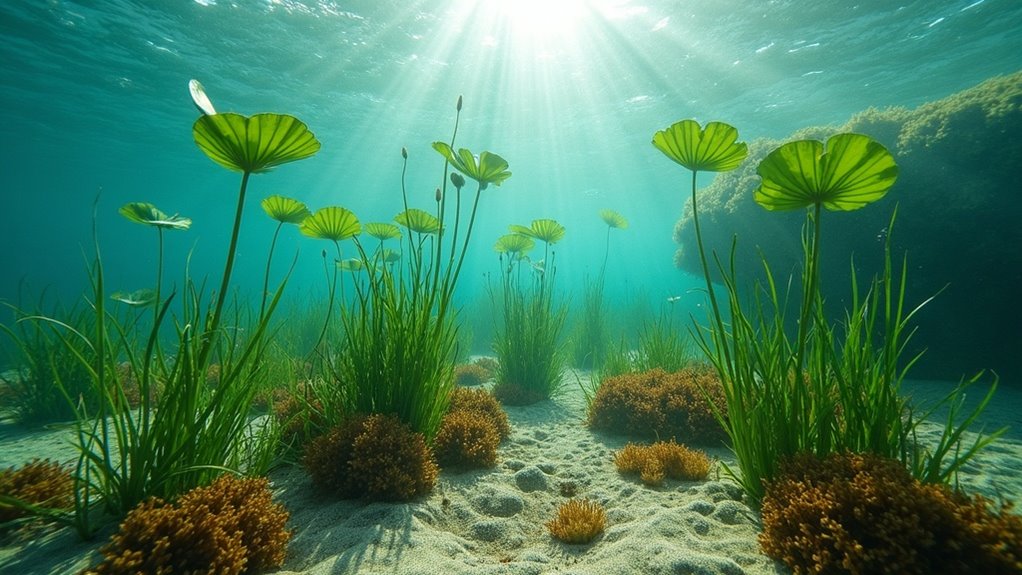
Aquatic plants are essential organisms found in water bodies, categorized into submerged, emergent, and floating types. Submerged plants, like elodea, grow entirely underwater, while emergent plants, such as cattails, rise above the surface. Floating plants, including duckweed, drift freely on the water’s surface. These plants serve critical ecological roles, such as improving water quality, providing habitats, and supporting food webs. Explore further to uncover their diverse adaptations and ecological significance.
Key Takeaways
- Aquatic plants are categorized into submerged, emergent, and floating species, each adapted to different water conditions.
- Submerged plants, like elodea, thrive underwater and improve water quality.
- Emergent plants, such as cattails, grow above water, providing essential habitats.
- Floating plants, including duckweed and water lily, drift on the surface, with some being invasive.
- Aquatic plants play vital roles in food webs, water filtration, and enhancing biodiversity.
Types of Aquatic Plants
When exploring the diverse world of aquatic plants, you’ll find they fall into three main categories: submerged, emergent, and floating plants.
Submerged plants, like elodea and naiad, thrive entirely underwater, promoting water quality and supporting aquatic life with their flexible tissues.
Emergent plants, such as cattails and bur-reed, extend above the water’s surface, providing structural stability and habitat.
Floating plants, including duckweed and water lily, drift on the surface, with some, like water hyacinth, becoming invasive species that can disrupt ecosystems.
Understanding these types of native aquatic plants is essential for maintaining biodiversity and ensuring healthy aquatic environments.
Classification of Aquatic Plants
In classifying aquatic plants, you’ll find two primary categories: macrophytes, which are visible to the naked eye, and microphytes, comprising microscopic organisms like phytoplankton.
Macrophytes further break down into emergent, submerged, floating-leaved, and free-floating plants, each with distinct growth forms and ecological roles.
Understanding these classifications is essential for effective management and conservation of aquatic ecosystems.
Types of Aquatic Plants
Aquatic plants can be classified into three primary categories based on their growth forms: submerged, emergent, and floating plants.
- Submerged plants like elodea are rooted underwater and rely on buoyancy.
- Emergent plants, such as cattails, grow along banks, featuring stiff stems that extend above the water.
- Floating plants, including water lilies and water hyacinth, float on the surface, with roots dangling in the water.
These aquatic macrophytes play an essential role in ecosystems, providing oxygen, habitat for aquatic animals, and contributing to nutrient cycling.
Understanding their classifications enhances your grasp of aquatic ecology.
Classification Categories
Classifying aquatic plants involves recognizing two primary categories: aquatic macrophytes and aquatic microphytes.
Macrophytes, visible to the naked eye, are further divided into emergent, submerged, floating-leaved, and free-floating plants. Submerged aquatic plants, such as elodea and naiad, anchor to the substrate, while emergent species like cattails grow in shallow waters, extending above the surface.
Floating-leaved plants, such as water lilies, rest on the water, and free-floating plants like duckweed drift freely.
In contrast, microphytes include microscopic algae, which are essential as primary producers, forming the foundation of aquatic food webs and maintaining ecological balance in these environments.
Morphology and Adaptations
In exploring the morphology and adaptations of aquatic plants, you’ll notice how buoyancy mechanisms, such as gas-filled lacunae, prevent structural limpness in submerged species.
You’ll also find that leaf configurations and stomatal placements are finely tuned to optimize gas exchange and nutrient absorption in aquatic environments.
Understanding these adaptations reveals the complexity and efficiency of these plants in their unique habitats.
Buoyancy and Structural Adaptations
Understanding buoyancy and structural adaptations in aquatic plants reveals how these organisms have evolved to thrive in diverse underwater environments.
These adaptations include:
- Gas-filled lacunae or aerenchyma cells in fully submerged plants, providing buoyancy and maintaining structure.
- Strong xylem and attachment mechanisms in river-dwelling species to resist water currents.
- Finely dissected leaves that minimize drag and enhance surface area for efficient mineral and gas exchange.
- Unique stomatal placement on free-floating plants’ upper leaves, optimizing gas exchange at the water surface.
Such phenotypic plasticity allows aquatic plants to adjust their structures in response to varying environmental conditions.
Leaf and Gas Exchange
How do aquatic plants optimize leaf morphology for effective gas exchange? Submerged aquatic plants often possess thinner leaves and flexible structures, relying on gas-filled lacunae for buoyancy. In contrast, floating aquatic plants have stomata exclusively on the upper surface, maximizing gas exchange while reducing water loss. River-dwelling species exhibit finely dissected leaves to minimize drag and enhance surface area for gas and nutrient absorption. Additionally, some can metabolize bicarbonate ions, improving carbon uptake in low-carbon environments.
| Type of Plant | Leaf Morphology | Adaptation Focus |
|---|---|---|
| Submerged | Thin leaves, flexible structure | Gas exchange |
| Floating Aquatic | Stomata on upper surface | Minimized water loss |
| River-dwelling | Finely dissected leaves | Reduced drag |
| Bicarbonate Metabolizers | Enhanced carbon uptake | Nutrient absorption |
Functions and Ecological Roles
Although often overlooked, aquatic plants play a crucial role in their ecosystems, serving as primary producers that underpin food webs and sustain diverse aquatic life. Their functions are critical for ecological balance:
- They filter pollutants and capture sediments, improving water quality.
- Aquatic plants provide habitats and spawning grounds, enhancing biodiversity.
- They compete with phytoplankton for nutrients, preventing overloads that harm ecosystems.
- Their presence influences riparian soil chemistry, promoting interactions between terrestrial and aquatic systems.
Effective management of aquatic plants is essential, particularly against invasive plants, to maintain healthy ecosystems and guarantee a sustainable food source for aquatic organisms.
Invasive Aquatic Plants
Invasive aquatic plants pose significant threats to native ecosystems, as they can rapidly outcompete indigenous species and disrupt local biodiversity.
Species like water hyacinth and purple loosestrife exemplify this issue; water hyacinth can double its biomass in two weeks, forming dense mats that block sunlight and deplete oxygen.
Meanwhile, purple loosestrife produces over two million seeds per plant, facilitating its swift spread in wetlands.
Other invasive species, like hydrilla, create dense submerged beds that disrupt aquatic habitats.
Effective management strategies, including mechanical removal and public awareness campaigns, are essential to mitigate the impacts of these invasive aquatic plants on ecosystems.
Threats to Aquatic Plants
As aquatic ecosystems face increasing pressures, various threats to aquatic plants emerge, jeopardizing their survival and the overall health of these habitats.
- Invasive plant species, like water hyacinth, outcompete native flora, disrupting ecosystems.
- Eutrophication, stemming from nutrient runoff, promotes harmful algal blooms, diminishing oxygen levels.
- Climate change alters precipitation and temperature, favoring non-native aquatic plants.
- Habitat degradation from urbanization and agriculture diminishes suitable environments for aquatic species.
To combat these challenges, effective management strategies, including controlling invasives and reducing nutrient inputs, are essential for preserving water gardens and maintaining biodiversity.





