
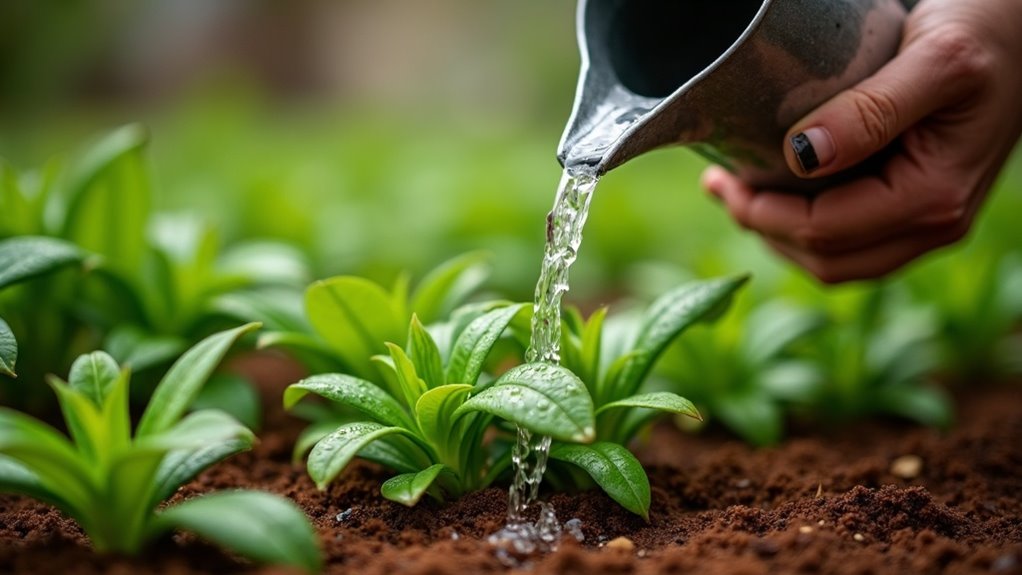
When watering plants in coco coir, aim for 90-100% saturation without letting it dry out completely. Start with daily watering, increasing to 3-5 times during flowering, ensuring 10-20% runoff to prevent salt buildup. Monitor pot weight and surface dryness to adjust your schedule. Regularly measure electrical conductivity (EC) to maintain nutrient balance, ideally between 0.8 to 1.5 mS/cm. With the right techniques, you can optimize growth and health for your plants. There’s more to explore on efficient watering practices.
Key Takeaways
- Water daily for seedlings and once daily for mature plants, increasing to 3-5 times during flowering.
- Aim for 90-100% saturation of coco coir to maintain optimal root moisture.
- Ensure 10-20% runoff with each watering to prevent salt buildup and maintain nutrient balance.
- Monitor pot weight and surface dryness to adjust your watering frequency effectively.
- Regularly measure electrical conductivity (EC) to maintain nutrient availability within the ideal range of 0.8 to 1.5 mS/cm.
Understanding Coco Coir
Coco coir, a versatile growing medium derived from coconut husks, offers a lightweight and aerated alternative to traditional soil. Its ability to hold moisture makes it ideal for maintaining a consistently moist root zone.
However, its low cation exchange capacity means it doesn’t retain nutrients well, necessitating frequent application of a nutrient solution. Aim for a saturation level of 90-100% to promote healthy root development, as proper gas exchange is essential.
Overwatering often results from inadequate oxygen rather than excess water, underscoring the importance of drainage and aeration in ensuring plant health with coco coir.
Feeding and Watering Is Fertigating
When using coco coir as a growing medium, understanding the role of fertigation is essential for ensuring ideal plant health.
Fertigation combines nutrient-rich solutions with irrigation water, providing consistent nutrient delivery to plants. Given coco coir’s low cation exchange capacity, you should start feeding and watering at 300-400 ppm, gradually increasing to 800 ppm.
Fertigation ensures consistent nutrient delivery in coco coir, starting at 300-400 ppm and increasing to 800 ppm for optimal growth.
Always flush previous feeds to prevent salt accumulation, aiming for 10-20% runoff. Regularly monitor electrical conductivity to fine-tune your approach.
High-frequency fertigation helps manage calcium and magnesium levels, preventing deficiencies and promoting robust plant growth throughout their lifecycle.
Coco Coir Watering Guide
When watering your coco coir plants, it’s essential to establish an ideal frequency that meets their needs, especially as they progress through different growth stages.
Monitor moisture levels by checking the pot’s weight and the surface dryness of the coir, adjusting your watering schedule accordingly.
This approach guarantees maximum saturation and supports healthy root development.
Ideal Watering Frequency
Watering plants in coco coir requires careful attention to frequency to verify ideal growth. Understanding the watering frequency helps maintain peak moisture levels. Follow these guidelines:
- Water daily initially, adjusting to 3-5 times during flowering for ideal saturation levels.
- Aim for a runoff of 10-20% to prevent salt buildup and guarantee even moisture distribution.
- Smaller containers may need watering every other day, while larger pots can be watered less frequently, depending on environmental conditions.
Monitor your coco’s moisture; if it feels coco dry, it’s time to increase the amount of water to support healthy root development.
Monitoring Moisture Levels
How can you guarantee your plants thrive in coco coir? Start by monitoring moisture levels closely. Aim for 90-100% saturation, and water until you see 10-20% runoff to prevent salt buildup.
Check the pot’s weight; a light pot signals underwatering, while excessive runoff indicates overwatering. Adjust your watering schedule based on the plant’s growth stage—seedlings may need daily water, while mature plants can require 3-5 times daily during flowering.
Regularly inspect the surface of the coco for dryness; never let it dry out completely to maintain ideal root health and nutrient uptake.
Watering Frequency for Cannabis Plants
Cannabis plants in coco coir require diligent attention to watering frequency to thrive. Here’s how to optimize your approach:
- Water seedlings in smaller containers at least twice daily and mature plants once daily.
- During the flowering stage, increase watering to 3-5 times daily to maintain moisture and nutrients.
- Guarantee 10-20% runoff with every watering to prevent salt buildup and maintain the right nutrient balance.
Monitor the pot weight and the surface of the coco coir for dryness to fine-tune your schedule.
Keeping the coco saturated between 90-100% moisture is essential for healthy growth.
Coco Coir Watering Schedule
Maintaining an effective coco coir watering schedule is vital for plant health, especially as they progress through different growth stages.
Start by watering your plants once daily, and increase to two or more times during flowering to meet their growing needs. Each watering should deliver 10-20% runoff to prevent salt buildup and guarantee proper coco saturation.
Water your plants daily, increasing to multiple times during flowering for optimal growth and saturation.
Aim to keep the medium between 90-100% saturation for ideal air-to-water balance, promoting healthy roots. Monitor pot weight; lighter pots indicate a need for water, while heavier ones suggest sufficient moisture.
Adjust your schedule based on the plants’ maturity to provide the right amount of water.
Handling Run-Off Effectively
While watering plants in coco coir, effectively managing run-off is essential for maintaining a healthy growing environment. Aim for 10-20% run-off with each watering to prevent salt build-up and guarantee ideal nutrient levels.
Here are three key practices to handle run-off effectively:
- Quickly remove excess run-off to avoid re-absorption, which can lead to over-saturation and root issues.
- Utilize plant elevators to improve drainage and airflow, enhancing run-off management.
- Install drain lines for efficient wastewater removal, keeping your watering system clean and functional.
Measuring Electrical Conductivity
To guarantee your plants thrive in coco coir, measuring Electrical Conductivity (EC) is crucial for maintaining ideal nutrient levels.
Ideal EC levels typically range from 0.8 to 1.5 mS/cm. Regularly measure the EC of both your nutrient solution and runoff EC to guarantee balanced nutrient availability and prevent buildup.
Ideal EC levels are crucial, ranging from 0.8 to 1.5 mS/cm; monitor both nutrient solution and runoff for balance.
High-frequency fertigation helps maintain these levels, ensuring essential nutrients like calcium and magnesium reach your plants without causing nutrient burn.
Don’t wait too long between waterings, as this can lead to high EC levels, stressing your plants.
Recommended Nutrients for Coco Coir
Choosing the right nutrients for plants grown in coco coir is crucial for their success, given the medium’s low cation exchange capacity (CEC).
To guarantee ideal growth, consider these key nutrients:
- Calcium and Magnesium – Essential for cell structure and photosynthesis.
- Nitrogen, Phosphorus, and Potassium – Critical for overall plant health and development.
- Sulfur – Significant for protein synthesis and enzyme function.
Regularly feed and water your plants, starting at 300-400 ppm and gradually increasing to 800 ppm.
Monitoring runoff EC/PPM helps maintain consistent nutrient levels, preventing stress and guaranteeing healthy coco coir grows.





