
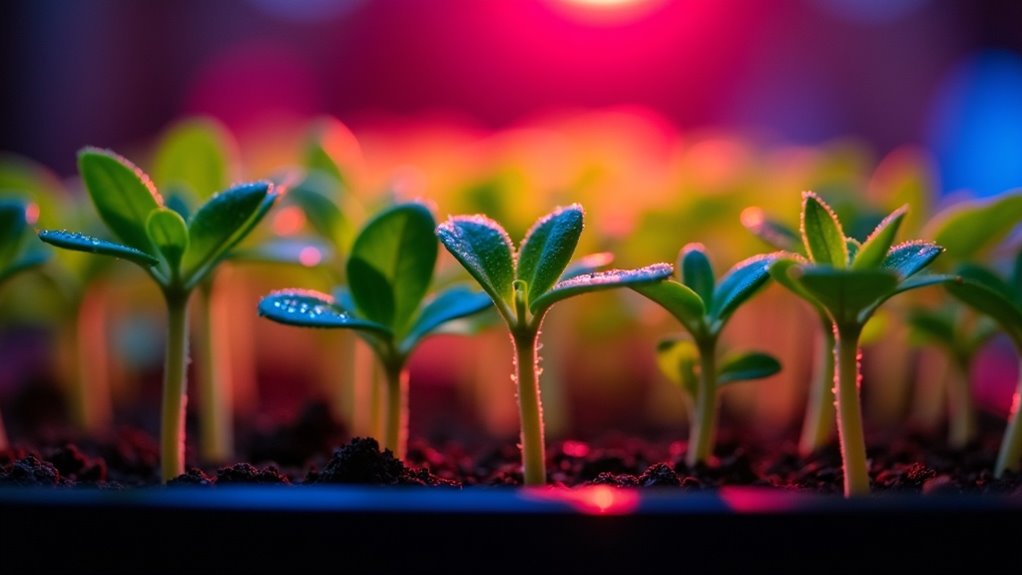
Yes, plants grow faster under red and blue grow lights due to their specific wavelengths that enhance photosynthesis. Blue light promotes chlorophyll production and sturdy vegetative growth, while red light accelerates flowering and increases fruit size. The ideal light ratio of blue to red is about 1:5 for healthy growth at various stages. Using these lights can boost growth rates by up to 30%. There’s more to discover about how light ratios can affect your indoor garden’s success.
Key Takeaways
- Red and blue light together optimize photosynthesis, enhancing overall plant growth rates significantly.
- Blue light promotes chlorophyll production, leading to healthier leaves and faster vegetative growth.
- Red light accelerates flowering and fruiting, improving yield and fruit size in crops.
- The ideal blue to red light ratio of about 1:5 boosts crop quality and growth efficiency.
- LED grow lights provide customizable light spectra that cater to specific growth stages, further enhancing growth rates.
Effects of Red and Blue Light on Plant Growth
When you consider how plants grow, it’s crucial to understand the key roles that red and blue light play in their development. The red and blue wavelengths in the light spectrum are important for maximizing plant development.
Blue light encourages chlorophyll production, necessary for robust vegetative growth, while red light stimulates flowering and enhances root growth.
Blue light boosts chlorophyll for strong growth, while red light promotes flowering and strengthens roots.
Using LED grow lights, which efficiently convert electricity into photosynthetically active radiation, guarantees optimal results.
Research shows that adjusting the light ratio—favoring blue for seedlings and red during the flowering stage—can greatly improve both crop yields and quality, making it a crucial practice for growers.
Understanding Light Spectrum and Plant Needs
To effectively support plant growth, you need to understand the light spectrum and its specific roles.
Blue light promotes vegetative growth by enhancing chlorophyll production, while red light is essential for flowering and fruiting.
Light Spectrum Basics
Understanding how light spectrum affects plant growth is essential for successful indoor gardening.
Plants primarily utilize red light (600-700 nm) and blue light (400-500 nm) to drive photosynthesis. Blue light encourages chlorophyll production, resulting in healthier leaves and robust root systems, while red light enhances flowering and fruiting processes.
For ideal growth, a common ratio of about 1:5 blue to red light is recommended, supporting different growth stages. Full-spectrum LED grow lights can provide this red-blue light spectrum, allowing you to customize conditions for your indoor plants, ultimately increasing growth rates by up to 30% under these effective lighting conditions.
Role of Blue Light
Blue light plays a critical role in plant development, greatly influencing chlorophyll production and overall health. This wavelength is crucial during the vegetative stage, enhancing growth and stability.
Key benefits include:
- Increased chlorophyll production, leading to healthier leaf growth
- Enhanced root development for sturdier plants
- Improved stem thickness, promoting compact growth
- Regulation of plant hormones, influencing phototropism
- An ideal blue to red light ratio around 1:5 for balanced growth
With adequate blue light, plants can exhibit growth rates up to 30% faster, making it essential for thriving seedlings and young plants in controlled environments.
Importance of Red Light
While many gardeners focus on blue light for vegetative growth, red light plays an equally significant role in the overall development of plants.
With wavelengths between 600-700 nm, red light stimulates flowering, fruit production, and seed germination. Combining red light with blue light creates an ideal environment for photosynthesis, enhancing chlorophyll production.
Research shows that a 2:1 ratio of red to blue light promotes increased flowering density and larger fruit sizes, especially in crops like tomatoes and cannabis.
Additionally, red light is essential for root growth and bulb development, making it critical for healthy, productive plant growth.
The Role of Blue Light in Vegetative Growth
Blue light, with wavelengths between 400 and 500 nm, plays a crucial role in promoting leaf development and enhancing root growth in plants.
When you provide your plants with adequate blue light, you’ll notice a significant increase in leaf density and root mass, leading to sturdier and healthier specimens.
This light spectrum not only supports essential chlorophyll production but also fosters the overall vigor necessary for peak vegetative growth.
Promotes Leaf Development
When plants receive adequate exposure to blue light, they experience significant enhancements in leaf development, leading to robust vegetative growth.
This spectrum is essential for optimizing chlorophyll production, which directly boosts photosynthesis.
Remarkably, you’ll observe:
- Stronger, healthier leaves in the vegetative stage
- More compact structures, reducing leggy growth
- Enhanced overall plant vigor, critical before flowering
- Improved stem thickness and stability
- Denser foliage due to regulated phototropism hormones
Enhances Root Growth
The interplay between light exposure and root development plays a significant role in the overall health of plants.
Blue light is vital for promoting chlorophyll production, enhancing photosynthesis, and fostering robust root growth during the vegetative growth stage.
Utilizing red blue LED lights can optimize this process, with studies showing a recommended blue light percentage of around 60% for maximum efficiency.
This exposure can lead to a 70% improvement in root development, enabling a thicker root system essential for nutrient uptake.
The Importance of Red Light for Flowering and Fruit Development
Red light is crucial for stimulating flowering and fruit development in plants, greatly influencing their growth dynamics. It enhances chlorophyll production, essential for effective photosynthesis, which in turn boosts plant growth.
Red light plays a vital role in promoting flowering and fruit development, significantly enhancing plant growth and health.
Key benefits of red light include:
- Accelerated flowering time
- Increased fruit size and quality
- Enhanced yield, especially in crops like tomatoes
- Improved root and bulb development
- Ideal light spectrum ratios, such as 2:1 red to blue
Understanding the role of red light allows you to create ideal conditions for your plants, ensuring robust flowering and fruitful harvests by leveraging its effects on photosynthesis and overall plant health.
Optimizing Light Ratios for Indoor Gardening
To achieve ideal plant growth indoors, it’s essential to carefully balance light ratios, as different light wavelengths greatly influence various growth stages.
For best results, aim for a 1:5 ratio of blue to red light during vegetative growth, where blue light supports bushy growth.
As plants shift to flowering, adjust to a 2:1 or 3:1 red-blue spectrum, enhancing flower size and fruit development.
Customizing these light ratios according to specific plant needs maximizes yield and quality while minimizing energy consumption.
Benefits of Using LED Grow Lights for Plants
Utilizing LED grow lights brings a multitude of advantages for indoor gardening, particularly when fine-tuning light ratios for ideal plant growth.
LED grow lights offer numerous benefits for indoor gardening, enabling precise adjustments for optimal plant growth.
Key benefits include:
- Energy efficiency: LEDs convert electricity into light more effectively than traditional systems.
- Customizable light spectra: Tailor the red-blue spectrum to meet specific plant needs.
- Enhanced photosynthesis: Improved chlorophyll production leads to stronger plants.
- Optimized growth: Supports both vegetative growth and flowering phases.
- Higher yields: Studies show growth increases of up to 30% in flowering plants.
Incorporating these grow lights can greatly improve your indoor gardening results.





