
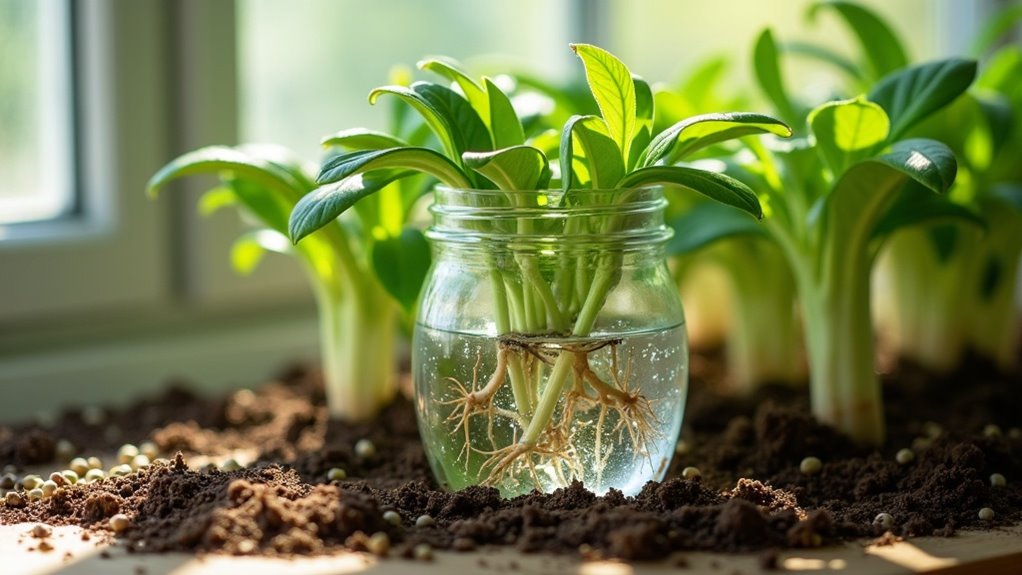
Plant propagation by cuttings is indeed faster than using seeds. You’ll see new plants established within weeks, skipping the lengthy seedling stage. Cuttings develop roots and foliage rapidly, while seeds can take months to germinate. Additionally, cuttings create genetically identical plants, ensuring you preserve desirable traits. This method is especially suitable for beginners seeking quicker results. To learn more about how to maximize success with cuttings, consider exploring different techniques and types of cuttings.
Key Takeaways
- Cuttings establish roots and foliage within weeks, while seeds can take months to germinate and mature.
- Asexual propagation through cuttings creates genetically identical plants, ensuring desired traits are retained.
- Rooting hormones used on cuttings enhance root development, leading to quicker establishment.
- Cuttings bypass the seedling stage, directly developing into mature plants faster than seeds.
- Overall, propagation by cuttings offers a more reliable and quicker growth cycle compared to seeds.
What Is Plant Propagation?
Plant propagation is the process of generating new plants from existing ones, and it can be achieved through two primary methods: sexual reproduction via seeds and asexual reproduction through cuttings.
Asexual propagation, particularly through cuttings, involves taking a portion of the parent plant and facilitating its root development, resulting in a genetically identical clone. This method not only preserves the desirable traits of the parent plant but also allows for quicker growth cycles.
For beginners, propagating through cuttings can be more straightforward, offering faster maturation and earlier harvesting compared to the seed-based method.
Advantages of Propagation by Cuttings
When you choose propagation by cuttings, you gain several advantages that can enhance your gardening success.
Cuttings allow for faster growth cycles, enabling new plants to mature more quickly than those from seed germination. You’ll produce genetically identical clones of the parent plant, preserving specific traits like color and flavor.
Additionally, cuttings typically establish roots within weeks, outpacing the slower rooting process of seeds. Utilizing rooting hormones, like Hormex, further boosts root development and increases survival rates.
This method eliminates uncertainties of seed quality, making cuttings a more reliable choice for achieving your desired plant characteristics.
Seed Growth vs. Cutting Growth
While cuttings offer quick results, it’s important to contemplate how they stack up against seeds regarding growth.
Cuttings typically establish roots and foliage within weeks, bypassing the seedling stage entirely, which accelerates the shift to harvest. In contrast, seeds can take months to germinate and mature.
However, seedlings often develop stronger root systems, enhancing resilience. Additionally, seeds promote greater genetic diversity, improving adaptability to environmental changes.
In contrast, cuttings produce genetically identical clones, potentially increasing susceptibility to diseases.
Ultimately, your choice between cuttings and seeds should consider growth speed, root strength, and genetic diversity for best results.
Techniques for Successful Cutting Propagation
Successful cutting propagation hinges on a few key techniques that guarantee ideal rooting and growth. Follow these steps to guarantee healthy cuttings thrive:
- Choose cuttings from new, green growth measuring 2-6 inches, with at least three sets of leaves.
- Process cuttings immediately or store them in water/plastic bags to prevent dehydration.
- Use rooting hormone on cut ends to enhance root development.
Additionally, enclosing your pot in a plastic bag maintains humidity, while a well-drained soilless mix guarantees proper air circulation.
Providing bright, indirect light and removing flowers or fruits helps focus energy on root development, increasing your chances of successful propagation.
Types of Cuttings
When propagating plants, understanding the different types of cuttings is vital for success.
You’ll find stem cuttings, leaf cuttings, and root cuttings each have unique methods and requirements, impacting your propagation outcomes.
Stem Cuttings Techniques
Stem cuttings are a popular propagation method due to their efficiency and speed, often rooting within just a few weeks.
To maximize success, consider these techniques:
- Use herbaceous cuttings from new growth for quicker results.
- Verify cuttings are 2-6 inches long with three sets of leaves for ideal photosynthesis.
- Apply rooting hormones like Hormex to enhance root development.
Make your cuts just below a node, and remove excess leaves to minimize water loss.
Leaf Cutting Methods
While many gardeners are familiar with stem cuttings, leaf cuttings offer an equally effective method for plant propagation, especially for species like African violets and succulents.
When propagating with leaf cuttings, trim the petiole or break off the leaf, and dip the cut end in rooting hormone to encourage root growth.
Place the cuttings in a well-drained rooting mix, and maintain humidity by covering the pot with a plastic bag.
Ascertain the cuttings receive bright, indirect light to aid photosynthesis while avoiding dehydration.
Monitor moisture levels closely, as leaf cuttings can be more susceptible to rot if conditions aren’t managed properly.
Root Cutting Procedures
Leaf cuttings provide a valuable alternative for plant propagation, but root cuttings can also be a highly effective method for certain species.
When using root cuttings, consider the following:
- Take healthy root sections 2-6 inches long.
- Lay them horizontally in a well-drained rooting mix.
- Keep the medium consistently moist, avoiding waterlogging.
This technique is especially useful for plants like oriental poppies and phlox, which can develop roots and sprout new stems from cuttings.
With proper care, you can successfully propagate plants from cuttings, leading to thriving plants grown from just a piece of the original root system.
Encouraging Root Formation in Cuttings
To successfully encourage root formation in cuttings, you must create the right environment and conditions for growth.
Start by placing the cuttings in bright light, avoiding direct sunlight to prevent stress. Trim excess leaves and flowers to minimize water loss, directing energy toward root development.
Applying rooting hormone will enhance the success rate, promoting faster root growth. Use a well-drained soilless potting mix to guarantee proper air circulation and prevent rot.
Finally, maintain humidity around the cuttings, perhaps by enclosing them in a plastic bag, to retain moisture and create an ideal environment for root formation.
Which Method Should You Choose?
Which method should you choose for plant propagation—cuttings or seeds? Consider the following factors:
- Speed of Growth: Cuttings offer quicker establishment, while seeds require patience for germination.
- Plant Types: Seeds provide diversity, ideal for annuals and vegetables; cuttings are perfect for replicating fast-growing plants like succulents.
- Space Efficiency: If you’re limited on space, cuttings can generate new plants without the challenges of seed propagation.
Ultimately, choose seeds for observing the full growth process or cuttings for exact replicas and faster results.
Choose seeds for a complete growth journey, or opt for cuttings for quicker, precise plant replicas.
Evaluate your goals to determine the best method for your propagation needs.





