
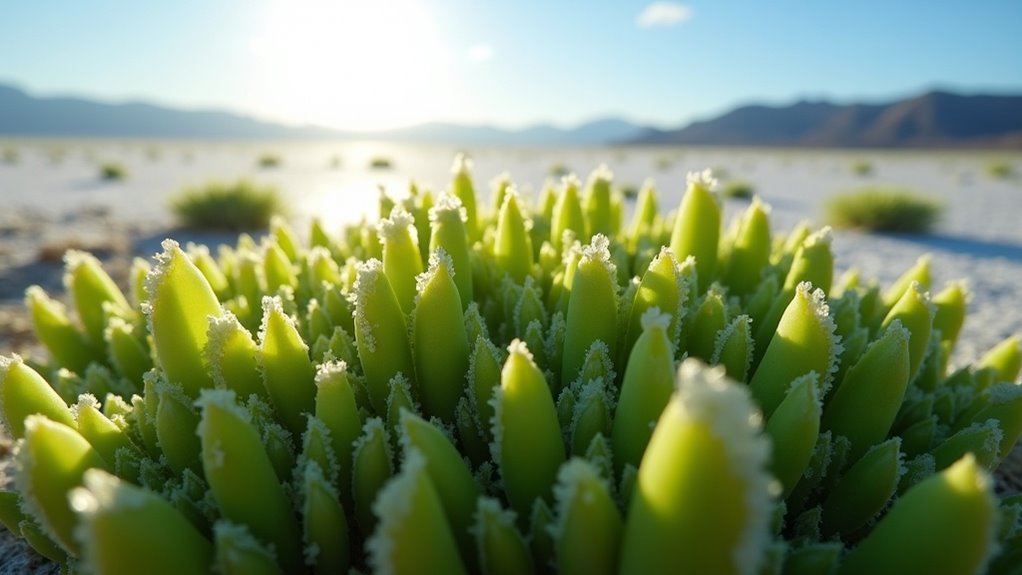
Halophytes are specialized plants that thrive in saline environments, demonstrating unique adaptations to high salt levels. Key examples include Spartina alterniflora, commonly found in coastal marshes, and Salicornia, known for its succulent, salt-tolerant structure. Other notable species are Atriplex, Distichlis spicata, and Sesuvium portulacastrum. These plants play significant ecological roles and offer agricultural potential in saline soils, ensuring biodiversity and sustainability. Discovering more about these fascinating species reveals their importance in various ecosystems.
Key Takeaways
- Halophytes such as Spartina alterniflora thrive in coastal marshes, adapting well to salt-rich environments.
- Salicornia species exhibit succulent structures that enable them to survive in highly saline conditions.
- Atriplex is versatile, thriving in various salinity levels, making it suitable for diverse habitats.
- Distichlis spicata flourishes in brackish and saline soils, showcasing strong salt tolerance.
- Sesuvium portulacastrum is commonly found in sandy coastal areas, demonstrating resilience to salt stress.
Overview of Halophytes
Halophytes are fascinating plants that, despite representing only 1-2% of the world’s flora, play essential roles in their ecosystems.
These specialized plants thrive in saline environments, showcasing remarkable salt tolerance. You’ll find two main types: obligate halophytes, which depend on salt for growth, and facultative halophytes, which tolerate salt but can also thrive in non-salty conditions.
Halophytes exhibit exceptional salt tolerance, with obligate types relying on salt and facultative types thriving in varied conditions.
Adaptations like salt glands that excrete excess salt and robust root systems for salt regulation enable their survival.
Their ecological importance is profound, as they stabilize soil, support biodiversity, and assist in land reclamation and wetland restoration, making them critical for maintaining healthy ecosystems.
Types of Halophytes
When exploring the types of halophytes, you’ll find a clear distinction between obligate and facultative varieties. Obligate halophytes, such as Glasswort, thrive exclusively in salty environments, while facultative halophytes can adapt to both saline and non-saline conditions.
Additionally, hydro-halophytes and xero-halophytes showcase the diverse adaptations within this group, with some requiring wet, saline habitats and others flourishing in arid, salty soils.
Obligate vs. Facultative Halophytes
Two primary types of halophytes exist: obligate and facultative.
Obligate halophytes, like Glasswort, require salt for growth and can’t survive in non-saline conditions. These specialized plant species thrive in extreme salinity, demonstrating remarkable salt tolerance.
In contrast, facultative halophytes, such as Cord Grass, can flourish in both saline and freshwater environments, allowing for greater adaptability. They tolerate a range of salinity levels, showcasing varying degrees of salt accumulation.
Understanding these distinctions is vital for comprehending plant community dynamics in saline habitats, as obligate halophytes often dominate the harshest environments, while facultative types contribute to ecological diversity.
Hydro-halophytes and Xero-halophytes
In coastal regions and arid landscapes alike, hydro-halophytes and xero-halophytes showcase remarkable adaptations to their saline environments.
Hydro-halophytes, like mangrove trees, thrive in wet, saline areas such as salt marshes, equipped with adaptations like aerial roots for gas exchange.
Conversely, xero-halophytes, such as the Frankincense tree, endure dry, salty soils, displaying features like thick, waxy cuticles to minimize water loss.
Both types are essential for stabilizing soils and preventing erosion, ultimately supporting biodiversity in their habitats.
Understanding these salt-tolerant plants helps you appreciate their ecological significance and resilience in challenging conditions.
Adaptations to Saline Environments
Halophytes, thriving in saline environments, have evolved a range of remarkable adaptations that enable them to survive and flourish where most plants would fail.
These halophytic plants exhibit succulence, storing water in fleshy stems and leaves, which minimizes water loss through transpiration. Specialized salt glands excrete excess sodium chloride, aiding in salt regulation and preventing toxicity.
Additionally, thick, waxy cuticles and small leaf sizes enhance water retention while shielding against harsh winds. Their extensive root systems, including pneumatophores and adventitious roots, access less saline substrates and anchor in unstable soils, ensuring stability and resilience in challenging conditions.
Ecological Importance of Halophytes
While often overlooked, the ecological importance of halophytes can’t be overstated, as these unique plants greatly contribute to the stability of saline environments.
Halophyte plants play a critical ecological role by stabilizing soil, preventing erosion, and enhancing biodiversity within coastal and salt marsh habitats. Their extensive root systems withstand tidal flooding, supporting land reclamation and the re-colonization of degraded areas.
Agricultural Potential of Halophytes
How can halophytes transform agricultural landscapes affected by salinity?
By thriving in saline soils, halophytes like Salicornia and Spartina offer agricultural possibilities previously unexploited. They adapt to saltwater irrigation, enabling you to cultivate crops in arid regions where traditional crops fail.
This innovation not only conserves freshwater resources but also enhances food supplies and animal forage options. Additionally, cultivating these species can restore saline wetlands, promoting biodiversity while generating biomass for sustainable products.
As climate change exacerbates salinization, harnessing halophytes becomes essential for future agricultural resilience and sustainability, making them a viable alternative in challenging environments.
Research and Development in Halophyte Cultivation
As researchers explore the complexities of halophyte cultivation, they uncover innovative strategies that could revolutionize agriculture in saline environments. Efforts focus on cross-breeding and genetic modification to develop salt-resistant varieties, greatly enhancing agricultural productivity in saline soils.
The Halophyte Biotechnology Center examines various halophyte species, testing their adaptability across climates in Thailand, China, and Egypt. At the University of Delaware, marine botanists investigate the survival mechanisms of halophytes, aiding agricultural applications.
Ongoing research highlights the potential of salt-marsh plants as food sources, while cultivating halophytes with saltwater irrigation offers a sustainable practice, conserving precious freshwater resources.
Examples of Halophytic Plants
When you explore notable halophyte species, you’ll find that each has unique adaptations to thrive in saline environments.
For instance, Spartina alterniflora excels in coastal marshes, while Salicornia utilizes specialized glands to manage excess salt.
Understanding their habitat preferences and ecological roles highlights the significance of these plants in maintaining coastal ecosystems.
Notable Halophyte Species
Halophyte plants exhibit remarkable adaptations that enable them to thrive in saline environments, with several notable species exemplifying these traits.
Here are three that stand out:
- Spartina alterniflora: This smooth cordgrass tolerates salinity levels exceeding seawater, essential for coastal ecosystems.
- Salicornia: Known as pickleweed, it accumulates salt in its tissues and is valued in culinary applications.
- Atriplex: Versatile halophytes like Atriplex patula and Atriplex hortensis show promise in soil rehabilitation across various saline conditions.
Additionally, mangroves and Distichlis spicata play crucial roles in coastal protection and forage, showcasing the resilience of halophytes.
Habitat Preferences
Many halophytic plants have evolved to thrive in specific saline habitats, each exhibiting unique adaptations that enable them to flourish in challenging environments.
In salt marshes, species like Spartina alterniflora and Salicornia bigelovii showcase remarkable salt tolerance. Conversely, mangrove trees dominate intertidal zones, withstanding saline inundation while supporting diverse wildlife.
Xero-halophytes, such as the Frankincense tree (Boswellia), adapt to arid, saline environments, demonstrating resilience in dry conditions.
Additionally, Atriplex species (saltbush) thrive in saline deserts and salt flats, contributing to soil stabilization.
These habitat preferences illustrate the diverse strategies halophytes employ to survive and thrive in various saline environments.
Ecological Importance
Although they often go unnoticed, halophytic plants like Spartina alterniflora and Salicornia play an essential role in maintaining the ecological balance of saline environments.
Their contributions include:
- Soil Stabilization: They prevent erosion, protecting coastal ecosystems.
- Biodiversity Enhancement: These salt-tolerant plants provide critical habitats for various wildlife species.
- Phytoremediation: By absorbing salts and heavy metals, they improve soil health in contaminated areas.
Halophytes are crucial for wetland restoration, especially in regions facing soil salinization.
Their unique adaptations make them indispensable for thriving saline habitats, supporting ecological resilience and food security.





