
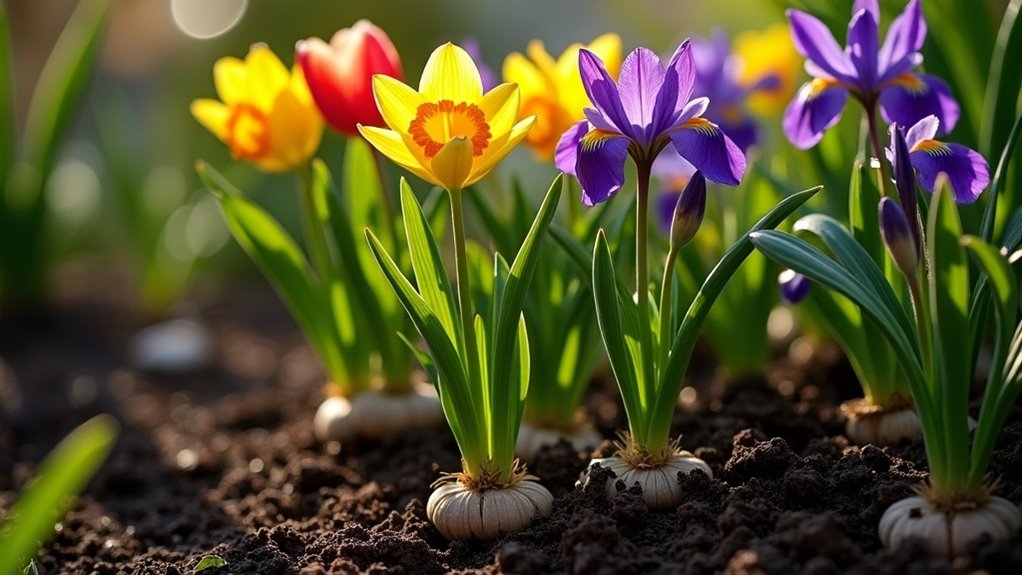
Geophytes are perennial plants like daffodils, garlic, and potatoes, characterized by their underground storage organs such as bulbs, corms, and tubers. These structures store essential nutrients and water, allowing them to adapt to various environments and survive adverse conditions. Bulbs, for instance, are layered for protection, while tubers function as nutrient reservoirs that can propagate when planted. Understanding these adaptations can enhance your knowledge of plant survival strategies in diverse ecosystems and their role in biodiversity.
Key Takeaways
- Geophytes include plants with underground storage organs, such as bulbs, corms, tubers, and rhizomes.
- Daffodils and garlic are common examples of geophytes with bulbs.
- Potatoes and yams are notable examples of geophytes that utilize tubers for nutrient storage.
- Corms are found in plants like crocuses and gladiolus, which adapt to harsh conditions.
- Rhizomes enable plants like bamboo and ginger to propagate and colonize effectively.
Understanding Geophytes
Geophytes, often referred to as “bulbous plants,” are remarkable perennial plants distinguished by their underground storage organs, which play a crucial role in their survival and growth.
These structures, including bulbs, tubers, corms, and rhizomes, enable geophytes to store important nutrients and water, ensuring regeneration during the growing season.
Common examples of geophytes include daffodils and garlic, which not only thrive in various environments but also withstand stresses like drought and frost.
Their underground storage organs enhance resilience, allowing these plants to contribute considerably to biodiversity and provide essential food sources for pollinators in their native habitats.
Types of Underground Storage Structures
While exploring the diverse world of underground storage structures, it’s essential to recognize the unique adaptations that allow plants to thrive in challenging environments.
Geophytes utilize various underground storage organs, including bulbs, corms, tubers, and rhizomes. True bulbs, like those of onions and tulips, consist of layered leaves protecting the central meristem during dormancy.
Geophytes employ various underground storage organs like bulbs, corms, tubers, and rhizomes to thrive in challenging environments.
Corms, as compressed stems, develop roots and produce cormels for asexual reproduction. Tubers, such as potatoes, store nutrients and can be propagated by planting sections.
Rhizomes, horizontal underground stems, enable rapid colonization and vegetative propagation, ensuring the survival of perennial plants in adverse conditions.
The Role of Bulbs in Survival
Bulbs play a pivotal role in the survival of various geophytes by serving as specialized underground storage organs that conserve carbohydrates and nutrients. These structures enable plants to withstand adverse environmental conditions, ensuring regeneration during growth periods. True bulbs, like onions and lilies, offer layered protection against predation and weather extremes. Their structural differences, such as imbricate and tunicate types, further enhance survival strategies. Additionally, bulbs can propagate asexually through underground bulblets, facilitating colonization. Their dormancy capability equips geophytes to endure heat, cold, and drought, akin to a natural disaster preparedness mechanism.
| Type of Bulb | Structure Description | Survival Benefit |
|---|---|---|
| True Bulbs | Layered structures | Protection against elements |
| Imbricate | Scales around the meristem | Enhanced regeneration |
| Tunicate | Concentric layers of modified leaves | Nutrient storage |
| Bulblets | Asexual propagation | Natural cloning and colonization |
Corms: Adaptations for Harsh Conditions
Corms serve as critical adaptations for plants thriving in harsh environments, enabling them to efficiently store carbohydrates and nutrients for periods of dormancy.
These compressed stem structures function as underground storage organs, distinct from bulbs due to their solid composition. Corms possess nodes and meristems, facilitating shoot regeneration in the growing season. Adventitious roots develop from the basal plate, anchoring the plant and enhancing moisture and nutrient absorption.
Species like gladiolus and crocus exemplify this adaptation, utilizing corms to endure extreme temperatures and water scarcity. Additionally, asexual reproduction through cormels promotes rapid colonization, ensuring survival in challenging climates.
Tubers: Nutrient Storage and Propagation
Geophytes utilize various underground storage organs to optimize survival and propagation strategies, and tubers are among the most effective adaptations. These thickened underground stems store carbohydrates and nutrients, primarily facilitating future growth.
For example, potatoes exemplify tubers, which can be propagated by planting sections containing at least one “eye” or bud. Additionally, tubers develop adventitious roots from their nodes, anchoring them in soil while efficiently absorbing water and nutrients.
Agricultural staples like yams and sweet potatoes also fall under this category, enhancing food security in numerous regions. Tubers’ dormancy allows plants to endure unfavorable conditions until growth resumes.
The Function of Roots in Geophytes
Roots play an essential role in the survival and growth of geophytes, acting as important storage organs that accumulate carbohydrates and nutrients.
These underground structures, such as those found in potatoes and carrots, provide energy reserves critical for the plant’s regeneration during growing seasons. Their fleshy roots not only support future growth but also enable geophytes to withstand adverse environmental conditions.
Underground structures like fleshy roots store energy, vital for geophytes’ growth and resilience against harsh conditions.
Additionally, roots facilitate anchorage, ensuring stability for the above-ground parts as they emerge.
Moreover, some geophytes utilize their roots for vegetative propagation, allowing new individuals to sprout from root cuttings or sections, enhancing their survival and distribution.
Crowns and Their Growth Mechanism
Although often overlooked, crowns serve as crucial underground storage structures in herbaceous perennials, enabling them to thrive through annual cycles of dormancy and growth.
These crowns store nutrients and energy, ensuring survival during unfavorable conditions. From these structures, dormant buds emerge, producing new shoots each year, allowing for vegetative propagation.
This mechanism not only supports regeneration but also facilitates rapid expansion of desirable plant varieties, appealing to gardeners and horticulturists alike.
For instance, agave plants utilize this method for uniformity in cultivation, particularly within the agricultural sector, such as in tequila production.
Understanding crowns is essential for effective plant management.
Propagation Through Stolons and Stem Layering
When you consider the methods of asexual reproduction in plants, propagation through stolons and stem layering stands out for its efficiency and effectiveness.
Stolons, which are horizontal stems, extend from the main plant, allowing for the development of new plants at various nodes. Similarly, stem layering involves shoot tips touching the soil to form adventitious roots.
- Enhances plant colonization
- Reduces local competition
- Promotes rooting through pegging
- Facilitates rapid expansion
Both techniques are essential for geophytes, enabling them to adapt swiftly to their environments and thrive in favorable conditions while producing new plants.





