
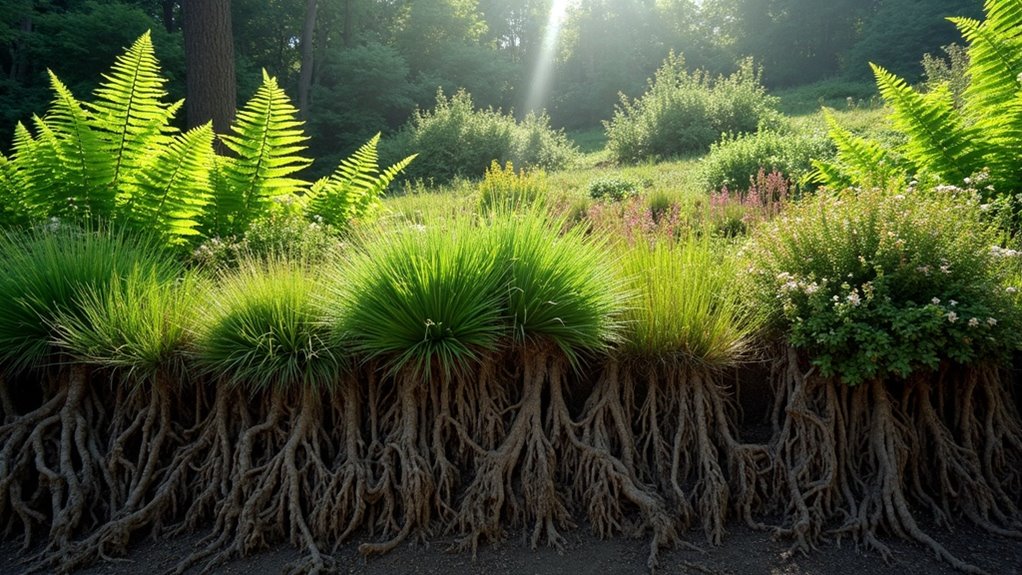
If you’re looking to stabilize slopes with strong roots, consider plants like Aronia, Juniper, and Red Switch Grass. Aronia forms dense thickets that anchor soil, while Juniper’s deep roots protect against erosion even in poor conditions. Red Switch Grass has a robust rhizome system that thrives across various soil types. Other options include Phlox and Diervilla, which also contribute to soil stability. Exploring these choices can enhance both the functionality and aesthetics of your landscape.
Key Takeaways
- Aronia (Black Chokeberry) has deep tap roots that stabilize soil on slopes, forming dense thickets for effective erosion control.
- Juniper (Tortuga variety) features deep roots and a fibrous network, anchoring soil in various environments while thriving in poor and drought conditions.
- Phlox (Mountainside ‘Majestic Magenta’) provides a low mat-forming growth habit, aiding in erosion control with its fibrous roots on rocky or sandy banks.
- Red Switch Grass possesses a deep, fibrous root system that effectively stabilizes slopes, supports pollinators, and thrives in diverse soil and moisture conditions.
- Diervilla (Diervilla x) has effective suckering roots that stabilize soil on slopes, ensuring low maintenance and providing habitat for local wildlife.
ARONIA
When considering plants for slope stabilization, Aronia melanocarpa, or black chokeberry, stands out due to its ability to form dense thickets that effectively combat erosion.
This native plant features deep tap roots, which stabilize soil and prevent displacement on slopes. Its adaptability to various soil types and moisture conditions further enhances its efficacy in erosion control.
Deep tap roots make Aronia melanocarpa a powerful ally in soil stabilization and erosion control across various environments.
The Low Scape Mound variety offers a compact option for smaller spaces while still providing robust soil stabilization.
With its dark green foliage and seasonal berries, Aronia not only serves a functional purpose but also adds visual interest to diverse landscapes.
JUNIPER
Aronia’s effectiveness in slope stabilization sets the stage for exploring Juniperus communis, or juniper, another valuable plant for managing erosion.
Juniper’s deep roots and fibrous network anchor soil, making it ideal for stabilizing slopes. Here are key benefits of using juniper:
- Hardy evergreen conifer adaptable to various environments.
- Tortuga variety spreads horizontally, effectively covering and protecting soil.
- Thrives in poor soils and drought conditions.
- Low-maintenance, requiring minimal care once established.
- Versatile in color, form, and size, enhancing landscape aesthetics.
PHLOX
Phlox, particularly the Mountainside ‘Majestic Magenta’ variety, serves as an effective solution for slope stabilization due to its low mat-forming growth habit.
This herbaceous perennial boasts fibrous root systems, which are essential for dealing with erosion on rocky or sandy banks. In addition to its functional benefits, Phlox produces vibrant dark pink flowers in early to mid-spring, enhancing landscape aesthetics.
Its adaptability to various soil types makes it a versatile choice among Native Plants for gardeners aiming to control erosion. Furthermore, its ability to spill over rock walls further solidifies its role in both erosion control and visual appeal.
RED SWITCH GRASS
Red Switch Grass (Panicum virgatum) serves as an effective solution for erosion control, thanks to its deep, fibrous root system that stabilizes slopes.
You’ll find its growth habits notable, as it can reach heights of up to 6 feet while spreading through dense rhizomes.
This adaptability allows it to thrive in various soil types and moisture conditions, making it ideal for both wet and dry environments.
Erosion Control Benefits
When considering effective erosion control on slopes, few plants rival the capabilities of Red Switch Grass (Panicum virgatum). Its robust, deep taproots not only hold the soil in place but also enhance stability against erosion.
Here are key benefits you should note:
- Native species promoting local biodiversity
- Dense rhizomes creating barriers against soil loss
- Adaptability to various soil types and moisture levels
- Thrives in full sun, adding aesthetic value
- Supports pollinators, enhancing ecological health
Growth Habits Overview
Erosion control benefits from the robust characteristics of Red Switch Grass, which plays an essential role in slope stabilization.
Its deep, fibrous root system effectively holds soil in place, particularly on steep slopes, preventing erosion during heavy rainfall. The grass thrives in dry conditions, demonstrating remarkable drought tolerance and adaptability to various soil types.
Once established, it requires minimal care, allowing it to flourish and enhance slope integrity. Growing 3 to 6 feet tall, Red Switch Grass provides vertical structure that mitigates wind and water impacts, further safeguarding the soil while contributing to local biodiversity and habitat for wildlife.
Ideal Growing Conditions
To achieve ideal growth and stability, Red Switch Grass (Panicum virgatum) requires specific ideal conditions that cater to its adaptability.
- Prefers full sun, needing at least 6 hours of sunlight daily
- Thrives in a range of soil types, including clay, loamy, and sandy
- Tolerates both dry and moist conditions, ideal for fluctuating moisture levels
- Establishes strong roots that enhance soil stability and prevent erosion
- Hardy in USDA Hardiness Zones 4 to 9, accommodating various climates
DIERVILLA
When considering erosion control on slopes, Diervilla stands out due to its effective suckering roots that stabilize soil.
This shrub not only thrives in a range of soil types but also requires minimal maintenance, allowing for easy integration into challenging landscapes.
Understanding its planting requirements and ongoing care will enhance both its aesthetic appeal and functional benefits.
Erosion Control Properties
While considering effective solutions for slope stabilization, Diervilla (Diervilla x) stands out due to its robust erosion control properties.
Its unique characteristics make it a top choice for maintaining soil integrity:
- Suckering roots effectively stabilize soil on slopes.
- Thrives in various soil types, ensuring versatility.
- Low-maintenance once established, reducing upkeep burden.
- Dense growth habit traps soil and minimizes runoff.
- Provides habitat and food sources for local wildlife.
These features collectively enhance Diervilla’s role in erosion control, making it a reliable option for ecological stability and slope management in diverse environments.
Planting and Maintenance Tips
Establishing Diervilla on slopes requires careful consideration of planting techniques and maintenance practices to maximize its erosion control benefits.
As a low-maintenance shrub, Diervilla adapts well to diverse soil types, making it ideal for soil stabilization. For best results, plant in clusters to promote suckering roots and create dense thickets.
Regular pruning encourages healthy growth and maintains shape, enhancing its effectiveness in erosion control. Additionally, applying mulch around the plants retains moisture, suppresses weeds, and further supports slope stabilization.
SWEETSPIRE
Sweetspire (Itea virginica) stands out as an ideal choice for slope stabilization due to its dense suckering growth habit, which effectively combats soil erosion.
This deciduous shrub thrives in wet soils, making it particularly suitable for moisture-prone areas.
- Produces fragrant white flowers in late spring
- Develops a fibrous root system to hold soil
- Reduces runoff and improves soil structure
- Adaptable to full sun and partial shade
- Enhances aesthetic appeal of landscapes
FORSYTHIA
Forsythia (Forsythia x) is a highly effective deciduous shrub for slope stabilization, especially when you consider its dense, spreading growth habit.
Its extensive root system firmly anchors soil, greatly reducing erosion on slopes. Forsythia thrives in full sun and can adapt to various soil types, making it versatile in different landscapes.
Once established, it becomes drought-tolerant, requiring minimal maintenance—ideal for low-care gardens. With a mature height and width of 8-10 feet, this shrub provides substantial coverage, enhancing both aesthetic appeal and functional soil stability.
Utilizing forsythia contributes to effective erosion control in challenging terrains.
ST. JOHNS WORT
St. John’s Wort (Hypericum kalmianum) is an essential choice for slope stabilization. Its deep taproots enhance soil stability, effectively preventing erosion. You’ll appreciate its rapid growth, providing dense ground cover to combat runoff.
Additionally, the plant boasts bright yellow flowers from late spring to early summer, offering aesthetic appeal alongside its functional benefits.
- Deer-resistant, ideal for areas with high populations
- Thrives in both wet and dry soil conditions
- Versatile for various slope environments
- Contributes to overall ecosystem health
- Supports biodiversity by attracting pollinators
Incorporating St. John’s Wort into your landscape can greatly bolster soil integrity.





