
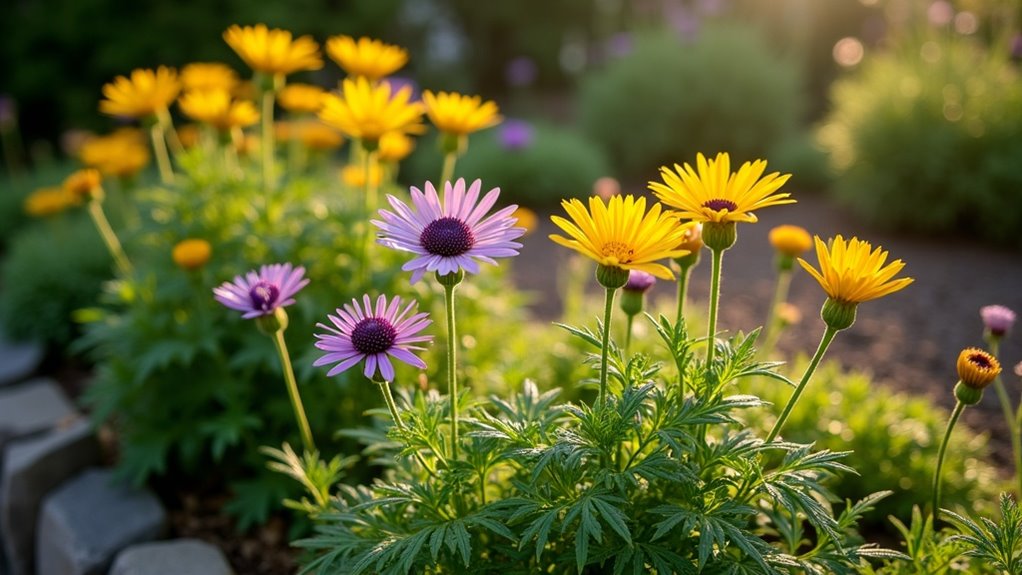
For low-maintenance gardens, consider planting perennials like Aster, Black-Eyed Susan, and Sedum. These plants thrive in various soil conditions and require minimal care once established. Aster blooms attract pollinators, while Black-Eyed Susan offers cheerful, self-seeding spreads. Sedum enjoys sun and poor soil, providing vibrant late-season blooms. Other remarkable options include Bee Balm and Daylily for their drought tolerance and visual interest. Explore more about these resilient plants to enhance your garden’s beauty and ease.
Key Takeaways
- Asters are drought-tolerant, bloom from late summer to fall, and attract pollinators, making them ideal for low-maintenance gardens.
- Black-Eyed Susans thrive in full sun, spread naturally, and require minimal care while providing vibrant summer to fall blooms.
- Sedums excel in poor soil, need little watering, and produce colorful flowers from late summer to fall, perfect for low-maintenance gardens.
- Bee Balm attracts various pollinators, blooms from late spring to fall, and is drought-resistant, contributing to biodiversity with minimal upkeep.
- Daylilies are versatile and resilient, adapting to different light conditions, blooming from late spring to fall, and requiring little maintenance once established.
Aster (Symphyotrichum Spp.)
Asters (Symphyotrichum spp.) are an ideal choice for gardeners seeking vibrant color with minimal upkeep. Thriving in USDA hardiness zones 3-10, these low-maintenance perennials flourish in full sun to partial shade.
Their upright or mounding habit reaches heights of 1 to 6 feet, creating seasonal visual appeal. Blooming from late summer to fall, asters not only provide striking hues but also attract pollinators like bees and butterflies.
Once established, they’re drought tolerant and adaptable to various soil types, making them relatively low-maintenance. Incorporating asters into your garden guarantees a resilient and colorful display throughout the growing season.
Black-Eyed Susan (Rudbeckia Spp.)
If you’re looking to add more vibrant colors to your garden, consider Black-Eyed Susan (Rudbeckia spp.), a hardy perennial that complements the display of asters beautifully.
These flowers bloom from summer to fall, attracting pollinators including bees, which enhances your garden’s biodiversity.
Growing between 1 and 4 feet tall, black-eyed Susans are adaptable to different soil types and thrive in full sun.
They’re heat and drought tolerant once established, making them low maintenance.
As they spread naturally, you’ll enjoy a cheerful and colorful landscape with minimal effort, proving that perennials come back year after year with stunning results.
Sedum (Sedum Spp.)
Sedum, or stonecrop, is an excellent choice for low-maintenance gardens due to its adaptability and drought tolerance.
You can easily incorporate it into various landscapes, from rock gardens to borders, while enjoying its vibrant foliage and blooms throughout the seasons.
Once established, Sedum requires minimal care, making it perfect for gardeners with busy lifestyles.
Growth and Care Tips
While you might think that low-maintenance plants require little attention, knowing how to care for Sedum (Sedum spp.) can enhance its resilience and beauty in your garden.
These perennials thrive in full sun and adapt well to poor soil conditions, needing minimal watering once established. Sedum’s drought-tolerant nature makes it perfect for low-maintenance gardens.
To maximize its blooming period, guarantee it receives ample sunlight, as this encourages the development of colorful flowers from late summer to fall.
Its low-profile growth habit makes it an excellent ground cover, effectively filling gaps in flower beds and rock gardens.
Seasonal Appeal and Uses
Although many gardeners appreciate Sedum for its low-maintenance qualities, its seasonal appeal is equally significant. This perennial plant blooms from late summer to fall, showcasing vibrant star-shaped flowers that attract pollinators. Its ability to thrive in poor soils requires minimal care, making it ideal for low-maintenance gardens. Additionally, Sedum’s dried blooms retain their visual appeal throughout winter, providing year-round interest.
| Season | Visual Appeal |
|---|---|
| Summer | Vibrant clusters of flowers |
| Fall | Colorful foliage changes |
| Winter | Dried blooms add interest |
Incorporating Sedum enhances both aesthetics and biodiversity.
Bee Balm (Monarda Spp.)
Bee Balm (Monarda spp.) thrives in a variety of climates, flourishing in Zones 3-9 with full sun to part shade exposure.
Its vibrant blooms attract pollinators like hummingbirds and butterflies while providing minimal care requirements once established, making it an excellent choice for busy gardeners.
With its drought resistance and aromatic foliage, Bee Balm not only enhances your garden’s beauty but also offers practical uses, such as herbal teas.
Ideal Growing Conditions
When considering the ideal growing conditions for Bee Balm (Monarda spp.), you’ll find that this resilient perennial adapts well to both full sun and part shade, offering versatility in your garden design.
Thriving in USDA zones 3 to 9, it’s perfect for various climates. Bee Balm grows upright, reaching heights of 1 to 4 feet and spreading 1 to 3 feet wide, creating a bold presence.
Its vibrant flowers bloom from late spring to fall, enhancing biodiversity. Once established, it’s drought resistant, requiring minimal care, making it one of the best low-maintenance plants to combat pests and diseases in your garden.
Attracting Pollinators
Attracting a diverse array of pollinators to your garden becomes effortless with the inclusion of Bee Balm (Monarda spp.), as its aromatic foliage and vibrant blooms serve as an irresistible invitation for hummingbirds, butterflies, and bees.
These flowers, available in shades of red, pink, purple, and white, provide essential nectar from late spring to fall, ensuring a steady food source for pollinators.
Thriving in full sun and drought-resistant once established, Bee Balm is a low-maintenance choice that supports pollinator populations.
Its upright growth habit, reaching 1 to 4 feet tall, creates a visually appealing habitat for these beneficial insects.
Minimal Care Requirements
While many plants require constant attention, Bee Balm (Monarda spp.) stands out for its minimal care requirements, making it an excellent choice for low-maintenance gardens. You’ll find it easy to grow, thriving in full sun to part shade. Once established, it needs minimal watering and is resistant to pests and diseases, allowing you to enjoy vibrant blooms from summer to fall without stress. This perennial will come back every year, enhancing your garden’s beauty.
| Care Aspect | Details |
|---|---|
| Watering | Minimal once established |
| Sun Requirements | Full sun to part shade |
| Height | 1 to 4 feet |
| Pest Resistance | Highly resistant |
| Blooming Period | Late spring to fall |
Daylily (Hemerocallis Spp.)
Daylilies (Hemerocallis spp.) are among the most versatile perennials you can choose for your garden, thriving in USDA Zones 3-9.
These hardy perennials adapt well to various light conditions, from full sun to partial shade, growing upright to heights of 1 to 6 feet. Blooming from late spring to fall, daylilies produce vibrant flowers in multiple colors, enhancing your garden’s appeal.
Once established, they’re low-maintenance and drought-tolerant, requiring minimal care. Additionally, daylilies show resilience against pests and diseases, making them suitable for a wide range of climates and an excellent choice for busy gardeners seeking beauty without the hassle.
Hosta (Hosta Spp.)
Hostas (Hosta spp.) are an exceptional choice for gardeners seeking vibrant foliage with minimal upkeep. These hardy perennials thrive in USDA zones 3-9, showcasing attractive leaves in shades of green, blue, and variegated forms.
Preferring partial to full shade, hostas are perfect for low-light garden areas while tolerating some sun, especially darker varieties. They grow upright in clumps, reaching heights of 2 inches to 4 feet and spreading between 5 inches to 5 feet wide.
With minimal maintenance required, hostas provide lush foliage that enhances visual interest throughout the season. Plus, they’re easily propagated through division for effortless expansion.
Purple Coneflower (Echinacea Purpurea)
If you’re looking for a stunning perennial that requires little care, consider the Purple Coneflower (Echinacea purpurea).
This hardy plant thrives in USDA Zones 3-9 and prefers full sun, making it an ideal choice for low-maintenance gardens.
Here are three reasons to love it:
- Drought-Tolerant: Once established, it needs minimal watering.
- Long-Lasting Color: Blooms from summer to fall, attracting pollinators like bees and butterflies.
- Self-Seeding: It can easily spread, creating naturalized patches without the need for replanting each year.
Incorporate purple coneflowers for vibrant, hassle-free gardening!





