
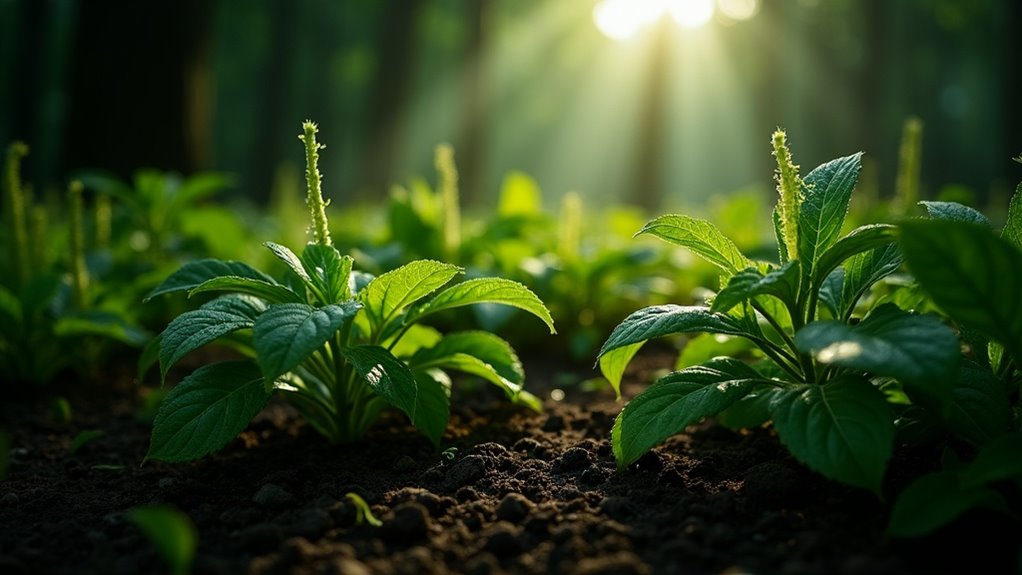
Yes, plants can adapt to lower light conditions by modifying their growth structures and processes. They increase leaf size, adjust chlorophyll concentration, and alter gene expression to enhance light capture and photosynthesis. Mechanisms like Shade Avoidance Syndrome allow them to thrive even in shaded environments. Key proteins regulate these adaptations efficiently. Understanding these responses is essential for improving agricultural practices and ensuring high yields. Discovering more about these adaptations could further enhance your insights into plant resilience.
Key Takeaways
- Plants can modify growth patterns, such as leaf size and shape, to adapt to lower light conditions.
- Shade-intolerant species may exhibit Shade Avoidance Syndrome, leading to smaller leaves when exposed to early shade.
- Increased chlorophyll concentration and broader leaves enhance light absorption efficiency in low-light environments.
- Genetic adaptations, like the expression of PIF7 transcription factors, drive growth responses under limited light conditions.
- Ongoing research focuses on enhancing crop resilience and optimizing photosynthetic efficiency in diverse light environments.
Understanding Plant Adaptability to Light Conditions
Understanding how plants adapt to varying light conditions is vital for optimizing agricultural practices and enhancing crop yields.
Plants exhibit remarkable plasticity, modifying growth patterns to maximize light capture. In shaded environments, shade-intolerant species experience Shade Avoidance Syndrome (SAS), increasing stem length while reducing leaf size.
Plants demonstrate incredible adaptability, altering their growth strategies to enhance light absorption in competitive shaded environments.
Early shade exposure leads to smaller leaves due to diminished cell division, while late exposure affects cell size.
Phytochromes play an important role in sensing light changes, triggering adaptive responses when the red to far-red light ratio decreases.
The Role of Photosynthesis in Plant Growth
Photosynthesis is the cornerstone of plant growth, converting sunlight, carbon dioxide, and water into essential sugars.
You’ll find that light absorption is critical, as chlorophyll captures specific wavelengths to drive this process, particularly in low-light environments.
To enhance their survival, many plants develop adaptations like broader leaves and increased chlorophyll concentration, maximizing their photosynthetic efficiency even under limited light conditions.
Photosynthesis Mechanism Overview
While many factors influence plant growth, the process by which they convert light into energy—photosynthesis—remains fundamental.
During photosynthesis, plants utilize chlorophyll to absorb sunlight, primarily in the red and blue wavelengths, transforming carbon dioxide and water into glucose and oxygen.
In low light conditions, plants adapt by developing larger, thinner leaves, maximizing light capture for efficient photosynthesis. These adaptations may also involve increased chlorophyll concentration, enhancing their ability to absorb light.
Understanding these mechanisms is essential for improving agricultural practices, particularly in boosting plant resilience and yield in varying light environments, ensuring ideal growth despite challenges.
Light Absorption Importance
Plants thrive primarily through their ability to harness light energy, a process that directly influences their growth and development. During photosynthesis, they convert sunlight, carbon dioxide, and water into glucose and oxygen, which are essential for survival.
Chlorophyll, the green pigment, absorbs specific light wavelengths, primarily red and blue, optimizing energy capture. In low light, plants adapt by increasing chlorophyll concentration and altering leaf structure, enhancing light absorption efficiency.
Such adaptations guarantee that shade-tolerant species maintain their growth rates, demonstrating the critical importance of light absorption in photosynthesis and overall plant resilience in diverse ecosystems.
Adaptations to Low Light
In environments where sunlight is scarce, the adaptations of certain plant species become apparent, revealing their remarkable strategies for maximizing photosynthesis.
Plants thriving in low light conditions often develop broad, thin leaves, maximizing surface area for sunlight capture. High chlorophyll concentrations enhance light absorption efficiency, essential in shaded habitats.
Structural features like larger leaf sizes facilitate light capture, while staggered leaf arrangements and adjustable orientations reduce self-shading, ensuring ideal light access.
Some species even employ alternative pathways, such as C3 photosynthesis, allowing effective energy conversion despite limited sunlight.
These adaptations illustrate the intricate relationship between photosynthesis and plant survival in challenging environments.
Structural Adaptations for Low Light Environments
How do plants survive and thrive in environments with limited light? They develop unique structural adaptations to maximize light absorption. For example, larger, thinner leaves increase surface area, while higher chlorophyll concentrations optimize photosynthesis. Leaf arrangement, like staggered phyllotaxy, reduces self-shading, enhancing light capture. Some species even thicken their leaves to conserve water while still maximizing light exposure. Broad leaf shapes further facilitate this process.
| Adaptation | Function | Benefit |
|---|---|---|
| Larger, thinner leaves | Increased surface area | Enhanced light absorption |
| Higher chlorophyll | Optimized light absorption | Improved photosynthesis |
| Staggered phyllotaxy | Minimized self-shading | Better light capture |
Gene Expression Changes in Response to Shade
When shade is detected, rapid gene expression changes occur, initiating a cascade of physiological responses vital for survival in low-light environments.
Research on Arabidopsis thaliana shows that significant alterations happen within five minutes, mainly driven by the activation of transcription factors like PIF7. The histone variant H2A.Z plays a significant role, as its absence allows activation of shade-responsive growth-regulating genes.
Notably, shade exposure mainly downregulates gene expression, affecting around 600 biological processes. Mutant seedlings lacking PIFs fail to exhibit growth responses to simulated shade, emphasizing the importance of these transcription factors in mediating shade avoidance mechanisms.
Key Proteins Involved in Photosynthesis Regulation
As plants adapt to low light conditions, they also face the challenge of optimizing photosynthesis under varying light intensities.
Key proteins like VCCN1 and KEA3 in plant cells play vital roles in this process. VCCN1 activates protective mechanisms against excessive sunlight, while KEA3 deactivates these systems when light decreases, enhancing photosynthesis efficiency.
Both proteins respond dynamically to the plants’ light environment and previous exposures, considerably influencing photosynthetic performance.
Understanding these regulatory mechanisms is essential for improving crop resilience and maximizing photosynthetic efficiency in fluctuating light conditions, ultimately aiding in the adaptation of plants to their changing surroundings.
Implications for Agriculture and Crop Yield
Understanding plant responses to lower light conditions can greatly enhance your crop resilience strategies.
By optimizing light utilization practices, you can develop shade-tolerant varieties that maximize photosynthesis and improve yield in densely planted environments.
This approach not only bolsters agricultural productivity but also contributes to broader goals like climate change mitigation.
Enhancing Crop Resilience Strategies
While the challenges posed by fluctuating light conditions are considerable, leveraging plants’ shade avoidance responses can greatly enhance crop resilience strategies.
Understanding mechanisms like increased stem elongation and earlier flowering allows you to develop crop varieties that thrive in low-light environments. Targeting transcription factors such as PIF7 through genetic modification optimizes performance under shade, boosting yield potential.
Additionally, enhancing genes linked to chlorophyll production and growth regulation bolsters shade tolerance, essential for adapting to climate variability.
Future research integrating realistic light dynamics will further refine agricultural practices, ensuring robust crops in diverse farming conditions and improving overall crop resilience.
Optimizing Light Utilization Practices
Optimizing light utilization practices is essential for enhancing agricultural productivity, especially in environments where light availability fluctuates. By understanding how plants respond to varying light conditions, you can select crop varieties that maximize light capture. Key proteins like VCCN1 and KEA3 regulate photosynthesis, guiding your practices. Implementing strategies based on shade avoidance mechanisms, such as PIF7 transcription factors, can improve growth in densely planted areas. Consider timing your planting to account for early and late shade exposure. Here’s a quick guide:
| Practice | Benefit |
|---|---|
| Selecting resilient crops | Improved yields |
| Mimicking natural light | Enhanced adaptability |
| Timing planting | ideal growth and yield |
Future Directions in Plant Research and Adaptation Strategies
As researchers explore deeper into plant adaptation strategies, they’re increasingly focusing on the molecular mechanisms that drive shade avoidance responses. Key among these are transcription factors like PIF7, which activate growth under low light conditions.
Future studies will investigate genetic traits enabling shade-tolerant plants to thrive, enhancing crop resilience. Additionally, examining photosynthetic efficiency in varying light conditions will reveal adaptations in leaf structure and chlorophyll concentration.
Ongoing research into gene expression related to light fluctuations aims to uncover pathways for improving crop performance in diverse agricultural settings, while optimizing biological processes influenced by shade will further inform growth strategies.





