
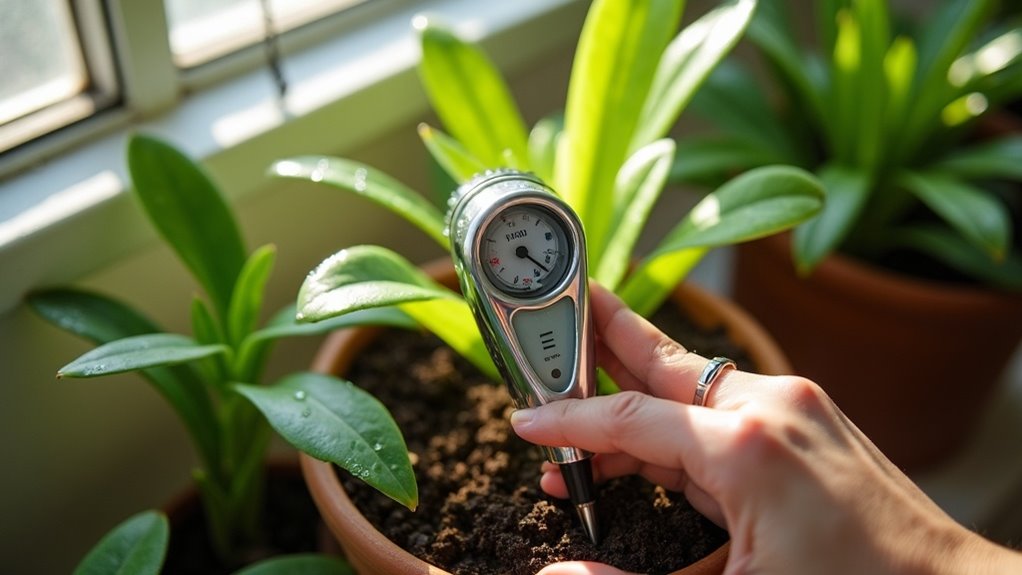
To effectively water your plants using a moisture meter, insert the probe deep into the soil, ideally halfway to the root zone. Wait about 10 minutes for a stable reading, then interpret the results: aim for levels between 4-7 for tropical plants, and 1-3 for cacti. Monitor moisture levels before and after watering to adjust your schedule as needed. Consistent checks will help you maintain ideal plant health, and there’s more to explore on moisture management techniques.
Key Takeaways
- Insert the moisture meter probe deep into the soil, ideally halfway to the root zone, for accurate readings.
- Wait at least 10 minutes after insertion for the moisture reading to stabilize before checking it.
- Categorize readings: aim for 4-7 for tropical plants, and 1-3 for cacti and succulents.
- Monitor moisture levels before and after watering to adjust your watering schedule effectively.
- Regularly calibrate your moisture meter to ensure consistent accuracy over time.
Understanding Your Moisture Meter
When you use a moisture meter, understanding its functionality is essential for effective plant care.
Moisture meters measure soil moisture levels through electrical resistance, providing accurate readings that help you prevent overwatering or underwatering. To use the device, insert the probe deep into the soil, ideally at the root zone, and allow it to sit for a few minutes for reliable results.
Regularly checking the soil moisture with this tool takes the guesswork out of watering, ensuring ideal moisture levels tailored to various plant types. This practice considerably enhances overall plant health and growth, making your gardening efforts more successful.
Best Practices for Using a Moisture Meter
To guarantee ideal plant health, it’s essential to follow best practices when using a moisture meter. Start by inserting the probe deep into the soil, ideally halfway. After 10 minutes, check the moisture reading to avoid corrosion and categorize it into zones:
For optimal plant health, insert the moisture meter probe halfway into the soil and wait 10 minutes for an accurate reading.
- DRY (1-3)
- MOIST (4-7)
- WET (8-10)
For tropical plants, maintain moisture levels in zones 4-7, while cacti should be watered at zones 1-3.
Regularly monitor moisture levels before and after watering to adjust your watering schedule.
Interpreting Moisture Readings for Different Plants
Understanding moisture readings is essential for tailoring your watering approach to different plant types. Use your moisture meter to assess the root zone, as readings from the top 2 inches may misrepresent actual soil moisture levels.
| Plant Type | Ideal Moisture Level | Time to Water |
|---|---|---|
| Marantas | 5-7 | When low |
| Cacti/Succulents | 1-3 | When low |
| Fiddle Leaf Fig | 4-6 | Regular checks |
| Monstera | 4-6 | Regular checks |
| Calatheas | 5-7 | When low |
Regularly monitor moisture levels to maintain peak health for your plants.
Tips for Accurate Watering Based on Meter Readings
Accurate watering hinges on how you interpret moisture meter readings. To guarantee you’re effectively evaluating soil moisture for your plants, follow these tips:
- Insert the moisture meter probe deep into the soil, ideally halfway to the root zone.
- Monitor the readings for at least 10 minutes to stabilize and confirm reliability.
- After watering, check the meter again to adjust your schedule based on how quickly your plants use moisture.
For tropical plants, aim for readings of 4-7, while cacti and succulents prefer 1-3.
Regularly calibrate your meter for consistent accuracy in moisture evaluation.
Maintaining Plant Health With Moisture Monitoring
While you might think watering is a simple task, maintaining plant health requires a keen awareness of soil moisture levels.
Regularly using a moisture meter allows you to assess moisture accurately, ensuring your plants get the right hydration without overwatering or underwatering.
Using a moisture meter ensures precise hydration, helping to avoid the pitfalls of overwatering and underwatering your plants.
Most indoor plants thrive at moisture levels between 4-7, so monitoring these with your meter is essential.
Inserting the probe deep into the soil helps you gauge moisture at the root zone, vital for root health.
This consistent monitoring enables you to adjust your watering schedule, preventing issues like root rot and dehydration, and promoting a thriving garden.





