
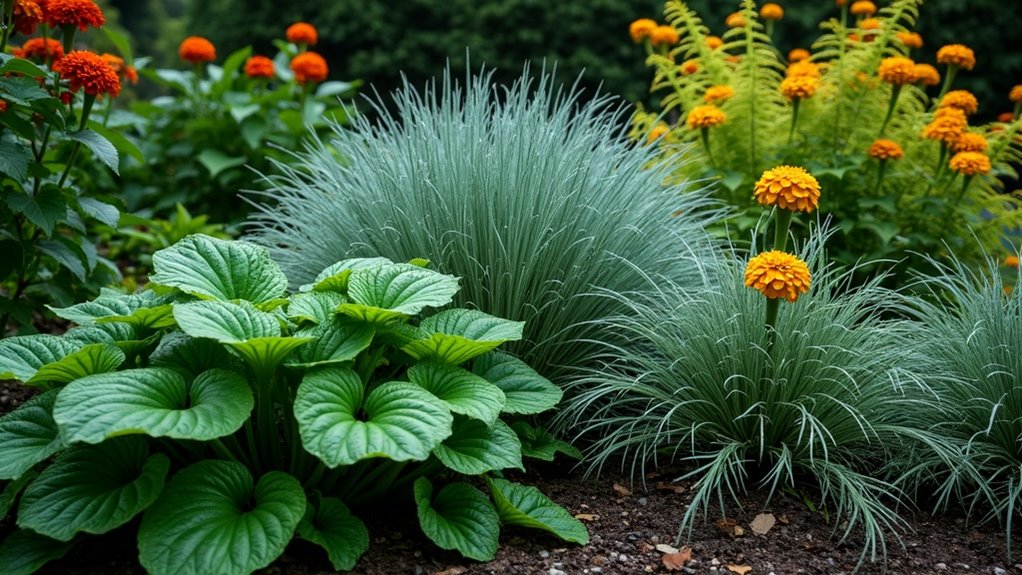
If you’re looking for slug-resistant plants that thrive in moist climates, consider Aquilegia, Penstemon, Euphorbia, Astrantia, and Alchemilla Mollis. Aquilegia offers stunning star-shaped flowers, while Penstemon attracts bumblebees with its colorful tubular blooms. Euphorbia’s milky sap deters slugs, and Astrantia adapts well to cooler, moist environments. Alchemilla Mollis features charming apple-green leaves and self-seeds for ground cover. These choices will enhance your garden and support local ecosystems; plus, there are even more options worth exploring.
Key Takeaways
- Aquilegia, or columbine, is a slug-resistant perennial that thrives in moist, well-drained soil and attracts pollinators.
- Penstemon features colorful, tubular flowers and offers slug-resistant foliage, blooming from early summer to first frosts.
- Euphorbia characias subsp wulfenii releases milky sap that deters slugs, thriving in sunny, well-drained locations.
- Astrantia, or masterwort, adapts well to moist soils and shade, showcasing star-like flowers throughout summer while being largely ignored by slugs.
- Alchemilla mollis, or Lady’s Mantle, has slug-proof foliage and grows well in various conditions, with self-seeding capabilities for lush ground cover.
Aquilegia
Although you might face challenges with pests in your garden, Aquilegia, commonly known as columbine, offers a resilient solution for moist climates.
This slug-resistant perennial thrives in both sun and light shade, making it versatile for various garden settings. It prefers moist, well-drained soil to flourish, so make sure you maintain proper moisture levels to avoid powdery mildew.
This resilient perennial thrives in sun or light shade, flourishing in moist, well-drained soil while resisting slugs and powdery mildew.
Significantly, Aquilegia vulgaris var. stellata, like the Yellow Star variety, showcases stunning star-shaped flowers that enhance your garden’s beauty.
Additionally, its unique bloom structure in early summer attracts beneficial pollinators, further enriching your garden ecosystem while remaining largely untouched by slugs.
Penstemon
Penstemon, or beardtongue, offers a stunning array of colorful tubular flowers that thrive in moist conditions, making it an ideal addition to your garden.
Not only do these plants provide vibrant accents, but they also attract essential pollinators like bumblebees, supporting local ecosystems.
With their slug-resistant foliage, Penstemon guarantees that your garden remains both beautiful and resilient against common pests.
Attractive to Pollinators
When you introduce Penstemon into your garden, you’ll not only enjoy its stunning tubular flowers but also create a vibrant habitat for various pollinators.
These slug-resistant plants thrive in well-drained soil and full sun, making them ideal for your diverse landscape. As they bloom from early summer to the first frosts, they support essential pollinator activity.
Here are some benefits you’ll appreciate:
- Attracts bumblebees and other beneficial insects
- Provides a lengthy color display
- Comes in a variety of colors: pink, red, purple, and white
- Enhances biodiversity in your garden
- Suitable for informal and cottage gardens
Colorful Garden Accents
Incorporating Penstemon into your garden offers a vibrant palette that enhances visual interest and complements a variety of landscapes.
Known for its slug-resistant characteristics, this plant features stunning, foxglove-like flowers in shades of pink, purple, and white, providing colorful accents from early summer to the first frosts.
With minimal slug damage, Penstemon thrives in full sun and well-drained soil, making it an excellent choice for moist climates.
As it attracts bumblebees and other pollinators, you’ll not only enjoy its beauty but also support biodiversity.
This durable option adds elegance and charm to any informal or cottage garden setting.
Tolerates Moist Conditions
While many plants struggle in consistently moist conditions, Penstemon thrives, making it an ideal choice for gardens that experience high humidity or regular watering.
This slug-resistant plant not only withstands wet environments but also enhances your garden’s aesthetic with its vibrant blooms.
- Produces foxglove-like flowers that attract pollinators
- Available in various colors for diverse design options
- Prefers well-drained soil to avoid root rot
- Long flowering period from early summer to first frosts
- Boosts biodiversity in moist garden settings
Choose Penstemon to guarantee continuous color and interest while enjoying its resilience in moist conditions.
Euphorbia
Euphorbia, particularly Euphorbia characias subsp wulfenii, features a unique milky sap that not only deters slugs but also adds an interesting element to your garden.
With a wide variety of species, including perennials and succulents, you can select options that suit your specific landscape needs.
When cultivating Euphorbia, remember to handle the plants with care due to the potential for skin irritation from that same sap.
Unique Milky Sap
When considering plants that deter slugs in moist climates, the unique milky sap produced by Euphorbia characias subsp. wulfenii stands out as a powerful defense mechanism.
This milky sap makes Euphorbia slug resistant by irritating slugs and snails, rendering the plant unpalatable.
- Acts as a chemical defense
- Irritates human skin upon contact
- Thrives in sunny, well-drained locations
- Provides structural interest and long flowering periods
- Versatile for various garden designs
Varieties and Cultivation Tips
Choosing the right varieties of Euphorbia for your garden can enhance both its aesthetic appeal and resilience against slugs.
Euphorbia characias subsp wulfenii stands out with its structural foliage and long flowering periods, thriving in well-drained soil. This slug resistant plant also tolerates some shade, making it versatile.
To optimize slug control, plant it in sunny locations, allowing it to flourish while deterring pests with its milky sap. Once established, Euphorbia is drought-tolerant, adapting to fluctuating moisture levels.
Use these striking plants in borders, as specimens, or in mixed perennial gardens to add interest and texture.
Astrantia
Astrantia, also known as masterwort, stands out as an exceptional choice for gardeners in humid climates due to its adaptability to moist soils and shade.
This slug-resistant perennial features striking star-like flowers that bloom throughout summer, attracting pollinators like bees.
Here’s what makes Astrantia a great addition to your garden:
- Thrives in cooler, moist environments
- Tolerates partial sun for versatile placement
- Large lobed leaves often ignored by slugs
- Notable cultivars like ‘Roma’ and ‘Moulin Rouge’
- Long-lasting blooms enhance garden aesthetics
Choose Astrantia for a beautiful, resilient garden that flourishes even in challenging conditions.
Alchemilla Mollis
Building on the theme of resilient plants for moist climates, Alchemilla mollis, commonly known as Lady’s Mantle, offers a unique combination of beauty and practicality.
Its distinctive apple-green, fan-shaped leaves are furry, making it slug proof and less enticing to slugs and snails. Thriving in both sun and shade, this hardy perennial adapts well to various garden conditions, particularly well-drained soil.
In early to mid-summer, it showcases delicate lime-green flowers, enhancing visual interest. Its self-seeding nature allows for lush ground cover while remaining easy to manage, making Alchemilla mollis an excellent choice for moisture-retentive landscapes.
Hellebores
Although hellebores may not be the first plants that come to mind for winter color, they’re exceptional choices for shaded gardens in moist climates.
These slug-resistant perennials showcase:
- Attractive, leathery, evergreen leaves that deter slugs
- Large clusters of saucer-shaped flowers in various colors
- Preference for moist, well-drained soil, ideal for planting under trees
- Hardy nature, able to thrive in diverse soil conditions
- Early blooming from late winter to early spring, providing nectar for pollinators
Incorporating hellebores into your garden won’t only enhance its beauty but also support local wildlife in those wetter areas.





