
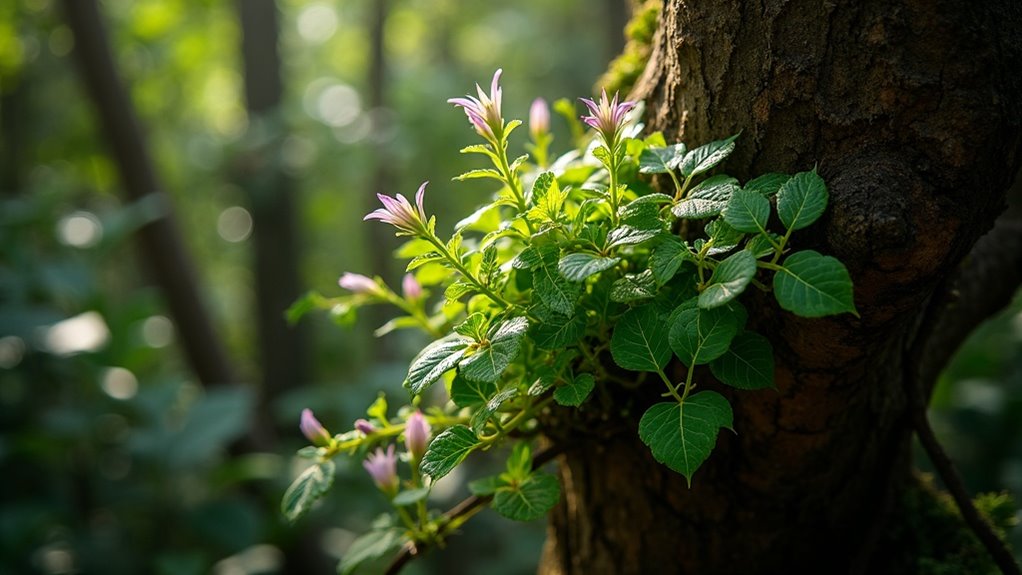
An epiphyte plant is a non-parasitic organism that grows on another surface, usually a tree, for physical support. They absorb moisture and nutrients from humid air, rainfall, and decaying organic matter. Common types include orchids, bromeliads, and ferns, each with unique adaptations like aerial roots and trichomes for efficient nutrient acquisition. These plants thrive in tropical and subtropical regions, playing a crucial role in ecosystem biodiversity. There’s more to discover about their fascinating life and care requirements.
Key Takeaways
- Epiphytes are plants that grow on other surfaces for physical support, not for nutrients.
- They primarily thrive in tropical and subtropical regions, absorbing moisture from the air.
- Common types include orchids, bromeliads, and ferns, with many relying on aerial roots.
- Epiphytes enhance biodiversity by creating habitats and contributing to nutrient cycling in ecosystems.
- They face environmental challenges, including limited nutrient access and competition with other epiphytes.
Definition and Characteristics of Epiphytes
Epiphytes are fascinating plants that thrive on other surfaces, primarily using them for physical support rather than for nutrients.
These perennial species, such as orchids and bromeliads, grow in tropical and subtropical regions, absorbing moisture from humid air, rainfall, and dew. They possess specialized adaptations, including aerial roots and modified leaves, to capture this moisture efficiently.
Unlike parasites, epiphytes don’t harm their host plants; instead, they rely on organic debris for nutrients, contributing to nutrient cycling.
Types of Epiphytes
In exploring the types of epiphytes, you’ll encounter a diverse array of species, primarily angiosperms like orchids and bromeliads, which dominate the landscape.
You’ll also find ferns, including leptosporangiate ferns, and unique classifications such as holo-epiphytes and hemi-epiphytes, each exhibiting distinct growth strategies.
Understanding their adaptations and traits is essential for appreciating their ecological roles and survival mechanisms within tropical ecosystems.
Common Epiphyte Species
Numerous species exemplify the diverse world of epiphytes, showcasing their remarkable adaptations to life in the canopy.
Common epiphyte species include orchids, such as Phalaenopsis and Dendrobium, which utilize aerial roots to absorb moisture and nutrients from the air and surrounding debris.
Bromeliads, like Aechmea fasciata, feature rosette-shaped leaves that collect rainwater, fostering microhabitats.
Ferns from the Polypodiaceae family thrive in high humidity, absorbing moisture through their fronds.
Unique air plants, or Tillandsia, don’t require soil and extract nutrients via trichomes.
Aroids, such as Anthurium and Monstera, display hemi-epiphytic behavior, rooting in the ground before climbing for ideal light conditions.
Classification of Epiphytes
Understanding the various types of epiphytes enhances appreciation for their ecological roles and adaptations.
Epiphytes are classified into holo-epiphytes, which complete their life cycle entirely above ground, and hemi-epiphytes, starting life rooted in soil before ascending onto other plants.
Approximately 89% of terrestrial epiphytes are flowering plants, with notable families including Orchidaceae (orchids), Bromeliaceae (bromeliads), and Araceae (aroids).
The Neotropics, rich in epiphyte diversity, host about 15,500 vascular epiphyte species.
Additionally, Leptosporangiate ferns and clubmosses contribute to the classification, comprising 10% and 1% of epiphyte diversity, respectively, highlighting the intricate relationships within these ecosystems.
Unique Adaptations and Traits
Epiphytes exhibit remarkable adaptations that enable them to thrive in their unique arboreal habitats.
These epiphytic plants have evolved to capture resources efficiently, allowing them to flourish in the high canopy.
Key adaptations include:
- Aerial roots that absorb moisture from humid air.
- Trichomes that capture nutrients from environmental debris.
- Water storage structures, like cup formations or pseudobulbs, to retain moisture and nutrients.
- Enhanced sunlight access, reducing competition with ground-dwelling plants.
These unique adaptations illustrate how epiphytes optimize their growth in challenging environments, showcasing their evolutionary strategies for survival and success.
Epiphytes vs. Parasites
When you examine epiphytes and parasites, you’ll notice significant differences in nutrient extraction methods and growth habits.
Epiphytes, like orchids, anchor themselves for support but absorb moisture and nutrients from the environment without harming their hosts, while parasites invade the root systems of other plants to siphon off essential nutrients.
This distinction not only highlights their contrasting survival strategies but also underscores their unique roles in ecological systems.
Nutrient Extraction Differences
While both epiphytes and parasites interact with host plants, their nutrient extraction methods are fundamentally different.
Epiphytes rely on specialized adaptations to extract nutrients available in their environment, using aerial roots and trichomes to absorb moisture and organic debris. In contrast, parasites directly extract nutrients from their host plants, often harming them by tapping into their vascular systems.
- Epiphytes don’t harm host plants, showcasing their non-parasitic nature.
- 89% of epiphyte species are flowering plants.
- Biodiversity thrives due to the coexistence of these plants.
- Epiphytes utilize rainwater and decomposed matter for sustenance.
Growth Habits Comparison
Understanding the growth habits of epiphytes and parasites reveals significant differences in their ecological roles and survival strategies. Epiphytes, like orchids, thrive on trees, using them solely for support while absorbing moisture and light from the environment. In contrast, parasitic plants penetrate their host’s tissues, extracting nutrients and often harming the host. This distinction influences ecosystem dynamics, with epiphytes enhancing biodiversity and habitats, while parasites can weaken or kill their hosts.
| Growth Habit | Epiphytes | Parasites |
|---|---|---|
| Nutrient Source | Absorb moisture from environment | Derive nutrients from host |
| Host Relationship | Harmless, supportive | Harmful, often detrimental |
| Life Cycle | May not contact ground | Dependent on host for survival |
Nutrient Acquisition in Epiphytes
Epiphytes, thriving in nutrient-scarce environments, have evolved unique mechanisms for nutrient acquisition that bypass traditional soil reliance. They primarily absorb moisture and nutrients from environmental sources such as rain, fog, and decaying organic matter on host plants.
Epiphytes thrive without soil, absorbing moisture and nutrients from rain, fog, and decaying matter on host plants.
- Many utilize specialized structures like trichomes for direct absorption.
- Bromeliads store water in leaf axils, capturing nutrients from rainfall.
- Epiphytic ferns, such as Asplenium, depend on leached water and decaying materials.
These adaptations enable epiphytes to prosper in high canopy habitats, enhancing nutrient cycling within forest ecosystems.
Understanding these mechanisms reveals the intricate relationships within nature.
Adaptations of Epiphytes
In nutrient-scarce environments, epiphytes exhibit remarkable adaptations that allow them to thrive without relying on soil. They possess specialized aerial roots that absorb moisture directly from the humid air and rain. Many, like bromeliads, develop unique structures to collect and store water for nutrient absorption. Additionally, trichomes on their leaves capture water and nutrients from dew and airborne particles. Epiphytes often form symbiotic relationships with fungi and bacteria, enhancing nutrient uptake from organic debris. Their lightweight seeds facilitate efficient dispersal by wind or animals, allowing colonization of new host plants in tropical areas.
| Adaptation | Description |
|---|---|
| Specialized Aerial Roots | Absorb moisture from humid air and rain |
| Water-Collecting Structures | Store water for hydration and nutrient absorption |
| Trichomes | Capture water and nutrients from dew and particles |
| Symbiotic Relationships | Aid in nutrient absorption from organic debris |
| Lightweight Seeds | Guarantee efficient dispersal for colonization |
Reproductive Strategies of Epiphytes
While traversing the challenges of their unique environment, epiphytes have developed diverse reproductive strategies that enhance their survival and proliferation. Their methods include:
- Producing feathery or dustlike seeds for efficient wind seed dispersal.
- Generating edible fruits to attract birds and other animals for seed distribution.
- Evolving flowers that specifically attract pollinators for successful fertilization.
- Synchronizing flowering and seed release with seasonal changes to boost adaptability.
These strategies allow epiphytes to thrive in various ecological niches, maximizing their reproductive success and improving survival rates in competitive habitats.
Understanding these mechanisms highlights their remarkable adaptability in complex ecosystems.
Popular Examples of Epiphytes
The world of epiphytes showcases fascinating plant adaptations, with notable examples demonstrating their unique survival strategies. Orchids like Phalaenopsis and Dendrobium thrive on tree bark, utilizing aerial roots for moisture. Bromeliads, such as Aechmea fasciata, feature colorful foliage and rosettes that capture moisture. Ferns from the Polypodiaceae family display feathery fronds in humid environments, while Tillandsia, or air plants, absorb nutrients through specialized leaves without soil. Hoya, known for thick leaves and fragrant flowers, often climbs trees for support.
| Plant Type | Notable Features |
|---|---|
| Orchids | Aerial roots, thrive on bark |
| Bromeliads | Colorful rosettes, moisture retention |
| Ferns | Feathery fronds, humid habitats |
| Tillandsia | No soil, absorbs through leaves |
Care Tips for Growing Epiphytes
To successfully care for epiphytes, you must replicate their natural habitat, which thrives in bright, indirect light typical of tropical canopies.
Successfully caring for epiphytes requires mimicking their bright, indirect light environment found in tropical canopies.
Follow these essential tips:
- Water thoroughly when leaves appear deflated, allowing the potting mix to dry between watering to prevent root rot.
- Use a well-draining potting mix, like orchid bark, to enhance airflow around the roots.
- Maintain humidity levels around 50-70% by misting or using humidity trays.
- Fertilize during the growing season with a diluted, balanced liquid fertilizer, avoiding over-fertilization that can damage your epiphytes.
Proper care guarantees ideal growth and health for your epiphytic plants.





