
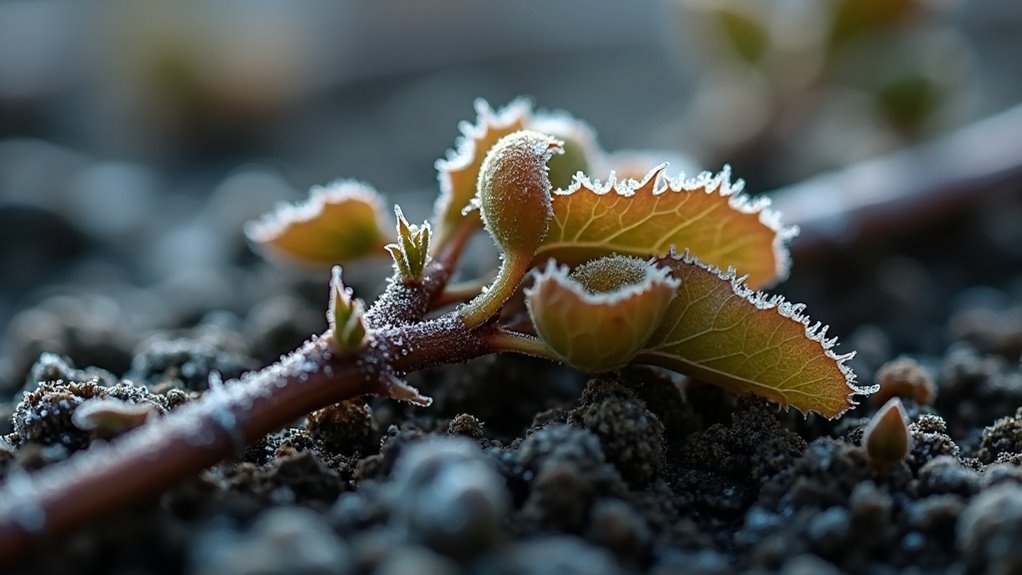
Dormancy in plants is a critical survival strategy that lets them endure tough environmental conditions by drastically reducing metabolic activity and conserving energy. This state is triggered by factors like cold temperatures, reduced daylight, and insufficient moisture. Different types of dormancy exist, including bud and seed dormancy, each adapting to specific challenges. By understanding how dormancy works, you can optimize growth and improve plant health. Explore further to uncover techniques for breaking dormancy and enhancing agricultural practices.
Key Takeaways
- Dormancy is a survival strategy that allows plants to endure unfavorable environmental conditions by significantly reducing metabolic activity.
- It can be triggered by factors such as cold temperatures, shorter days, insufficient moisture, and limited nutrients.
- Perennial plants exhibit bud dormancy, while annual plants rely on seed dormancy to withstand adverse conditions.
- Breaking dormancy can be achieved through temperature manipulation, light exposure, and chemical agents like gibberellins.
- Dormancy optimizes plant growth by preventing premature germination and conserving energy during harsh conditions.
Definition and Mechanism of Dormancy
Dormancy in plants serves as a strategic survival mechanism, allowing them to withstand periods of unfavorable environmental conditions. During this phase, plants considerably reduce metabolic activity, conserving energy for when conditions improve.
Triggers like decreasing temperatures and shorter days signal the onset of dormancy in species such as deciduous trees. Plant hormones play a key role in regulating dormancy mechanisms, determining whether a plant enters predictive or consequential dormancy.
While aboveground growth may cease, roots often continue to develop. Understanding these processes is essential for agriculture, as breaking dormancy artificially can enhance growth and improve crop yields effectively.
Types of Dormancy in Plants
When you explore the types of dormancy in plants, you’ll encounter both perennial and annual strategies that guarantee survival.
Perennial plants typically exhibit mechanisms like bud dormancy, which protects their growth during adverse conditions, while annual plants rely on seed dormancy to withstand unfavorable environments until conditions improve.
Understanding these mechanisms and the environmental triggers involved is essential for comprehending how plants adapt to their surroundings.
Perennial Dormancy Mechanisms
As temperatures drop and daylight shortens, perennial plants activate various dormancy mechanisms to endure harsh conditions.
During the dormancy period, these plants minimize metabolic activity and conserve resources, often shedding leaves in response to environmental conditions.
There are two main types of dormancy: predictive, where plants prepare in advance for adverse weather, and consequential, which reacts directly to unfavorable triggers.
Bud dormancy typically occurs due to low temperatures and limited nutrients, fully setting in by fall.
Breaking dormancy can be stimulated artificially through changes in temperature or light, promoting growth as the growing season approaches.
Annual Seed Dormancy
Perennial plants prepare for adverse conditions through various dormancy mechanisms, but annual seeds have their own unique strategies to guarantee survival.
Annual seed dormancy allows seeds to remain inactive until environmental conditions favor germination. Hard seed coats restrict water and gas uptake, preventing premature sprouting.
Some seeds face internal dormancy, where physiological barriers, influenced by abscisic acid, inhibit germination even under suitable external conditions.
Dormancy duration varies; some seeds require specific cues like light or chilling to germinate.
Effective agricultural practices can artificially break dormancy using methods like mechanical scarification or gibberellins, promoting quicker, uniform germination in crops.
Bud Dormancy Factors
Bud dormancy is an essential survival strategy that plants employ to withstand adverse environmental conditions. This process involves two types: paradormancy, where neighboring buds inhibit growth, and endodormancy, marked by physiological changes within the bud.
Environmental factors like low temperatures, short-day photoperiods, and nutrient scarcity trigger dormancy onset, allowing for energy conservation during winter. Chilling hours are important, as many species require specific low-temperature exposure to break dormancy in spring.
Abscisic acid regulates these processes, influencing growth inhibition and the timing of bud reactivation when conditions improve. Understanding these factors helps in managing plant growth successfully.
Environmental Factors Influencing Dormancy
When environmental conditions shift, such as the onset of colder temperatures and reduced daylight, plants respond by entering a state of dormancy. This adaptation allows them to survive unfavorable conditions. Insufficient moisture and nutrients in late summer can also trigger dormancy, ensuring seeds and buds remain inactive until resources improve. Cold temperatures contribute to dormant bud formation in perennials, essential for enduring harsh winters. Light exposure plays a role as well; some seeds need light for germination, while others may enter dormancy in low-light scenarios.
| Environmental Factor | Effect on Dormancy | Examples |
|---|---|---|
| Cold Temperatures | Induces dormancy | Perennial plants |
| Reduced Daylight | Triggers dormancy | Many seed species |
| Insufficient Moisture | Promotes seed dormancy | Various plant types |
| Limited Nutrients | Supports bud inactivity | Trees and shrubs |
| Light Exposure | Influences germination | Light-requiring seeds |
Breaking Dormancy: Techniques and Agents
To successfully break dormancy, various techniques and agents are employed to mimic the natural conditions that signal plants to resume growth.
Temperature manipulation and light exposure are essential environmental factors, while chemical agents like gibberellins, ethylene, and cytokinins effectively promote germination.
For cold-requiring species, gibberellins are particularly beneficial.
Mechanical methods, such as scarification of seed coats, increase water and gas permeability, facilitating germination.
In fruit trees, treatments like ethylene chlorohydrin help release dormancy, ensuring timely growth and fruit production.
Understanding these dormancy patterns enhances your ability to manage plant growth and optimize agricultural practices.
The Role of Dormancy in Plant Survival
Dormancy serves as an essential energy conservation strategy for plants facing adverse conditions, allowing them to minimize metabolic activities and preserve resources.
This seasonal adaptation mechanism guarantees that plants can withstand extreme cold or drought, enhancing their survival prospects until favorable conditions return.
Energy Conservation Strategy
As environmental conditions become unfavorable, many plants adopt dormancy as an essential energy conservation strategy. During this phase, physiological changes occur, considerably reducing metabolic activity.
Perennial plants, for instance, enter dormancy in winter, shedding leaves to minimize energy expenditure and halt photosynthesis. The hormone abscisic acid plays a pivotal role, signaling roots to reabsorb nutrients from leaves.
This process not only prepares plants for freezing temperatures but also guarantees efficient resource allocation during harsh conditions.
Seasonal Adaptation Mechanism
When environmental conditions become harsh, plants employ dormancy as a crucial seasonal adaptation mechanism to enhance their chances of survival. This process involves a significant reduction in metabolic activity, allowing them to conserve energy.
Key aspects include:
- Perennial plants entering dormancy during winter, shedding leaves to protect their roots.
- Environmental cues like temperature drops and shorter days trigger this state.
- Seed dormancy, preventing premature germination, guarantees seeds only sprout under favorable conditions.
Understanding these mechanisms is essential for effective agricultural practices, influencing growth cycles, irrigation, and fertilization strategies across varying climates, ultimately promoting sustainable growth.
Implications for Agriculture and Gardening
Understanding the concept of dormancy is essential for effective agricultural and gardening practices, as it directly influences planting schedules and resource management.
Dormancy allows crops like deciduous fruit trees to conserve energy during adverse conditions, preventing frost damage. By monitoring nutrient levels through changes in plant sap, you can tailor fertilization strategies for peak growth.
Additionally, you might consider artificially breaking dormancy using techniques like gibberellins to accelerate plant growth. Utilizing native perennials enhances resilience, minimizing water and nutrient competition.





