
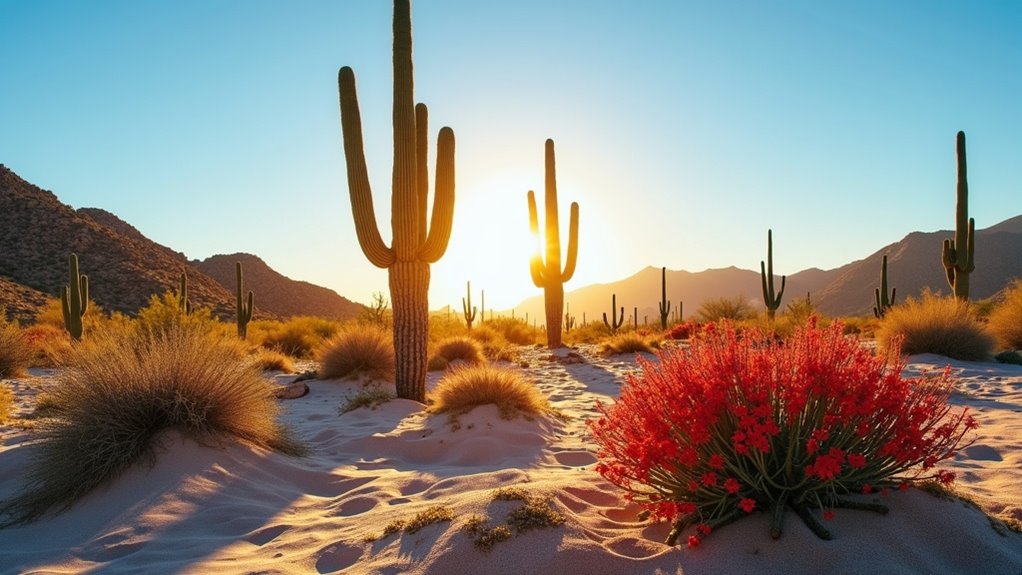
In the desert, you’ll find plants like barrel cacti, California poppies, and desert ironwood trees. These species have developed adaptations such as water storage in thick stems and deep root systems to access groundwater. They also practice drought-deciduous behavior, shedding leaves to conserve moisture. Additionally, many utilize modified photosynthesis methods to minimize water loss. Each plant plays a crucial role in maintaining the desert ecosystem. Explore further, and you’ll discover more fascinating details about their survival strategies.
Key Takeaways
- Desert plants, like the Barrel Cactus, store water in their stems and have ribbed surfaces to maximize hydration.
- The California Poppy features bright blooms and a rapid growth cycle, thriving in brief periods of moisture.
- Century Plants produce flowers only once in their lifetime and have toxic foliage that deters some animals.
- Desert Ironwood Trees possess deep root systems to access groundwater, essential for survival in arid conditions.
- Ocotillo showcases vibrant blooms post-rainfall, attracting pollinators and contributing to desert biodiversity.
Overview of Desert Plants
Desert plants, which thrive in some of the harshest environments on Earth, showcase remarkable adaptations that enable them to survive in arid conditions.
These plants, including cacti and succulents, are adapted to store water in their stems and leaves, ensuring hydration during droughts. Their deep taproots access groundwater, while some species exhibit drought-deciduous behavior, shedding leaves to conserve moisture.
Such adaptations are essential for maintaining the delicate balance of desert ecosystems, providing indispensable food and habitat for wildlife.
Notable Desert Plants and Their Characteristics
Among the most remarkable plants in arid regions are the Barrel Cactus, California Poppy, and Century Plant, each exhibiting unique characteristics tailored for survival. The Barrel Cactus stores water, has ribbed stems, and attracts pollinators like bees. The California Poppy, with its bright blooms and rapid growth, thrives in desert conditions despite its toxic foliage. The Century Plant produces flowers once in its lifetime, drawing pollinators while being toxic to some animals. Additionally, the Desert Ironwood Tree, with deep root systems, accesses groundwater, while the Ocotillo showcases vibrant blooms after rainfall.
| Plant | Characteristics |
|---|---|
| Barrel Cactus | Water storage, ribbed shape |
| California Poppy | Bright blooms, rapid growth cycle |
| Desert Ironwood Tree | Deep roots, dense durable wood |
Adaptations of Desert Plants
Plants in arid environments have evolved a range of remarkable adaptations that enable them to thrive under extreme conditions.
Desert plants typically feature thick, fleshy stems or leaves for water storage, allowing them to endure prolonged drought. Their root systems may include deep taproots or extensive shallow roots, optimizing moisture absorption from scarce groundwater or rare rainfall.
To minimize transpiration, many species possess modified leaves, such as spines or waxy surfaces. Additionally, some utilize CAM photosynthesis, opening stomata at night to capture CO2.
Rapid growth cycles facilitate germination, blooming, and seed setting quickly, ensuring reproductive success when moisture availability occurs.
Survival Strategies in Desert Environments
Surviving in harsh environments requires innovative strategies, and desert flora exemplify this resilience through various mechanisms.
Desert plants showcase remarkable resilience, employing innovative strategies to thrive in harsh environments.
Key survival strategies include:
- Dormancy: Plants enter dormancy during drought periods to conserve water and resources.
- Drought-deciduous behavior: Shedding leaves minimizes water loss, allowing regrowth when moisture returns.
- Modified photosynthesis: Utilizing Crassulacean Acid Metabolism (CAM), they open stomata at night, reducing water loss in daytime heat.
- Rapid germination: Following rainfall, plants quickly germinate, producing colorful blooms to complete their life cycles before the next dry spell, while some develop hairy or spiny surfaces to deter herbivores.
Frequently Asked Questions About Desert Plants
What makes desert plants so uniquely resilient in extreme conditions?
Desert plants adapt remarkably to arid conditions through specialized features. For instance, the barrel cactus excels in water storage, while deep root systems help it and others like the creosote bush access essential underground water during droughts.
The California poppy, with its vibrant blooms, employs toxic strategies to deter desert wildlife.
Additionally, plants like desert sage utilize unique photosynthesis methods, such as CAM, to optimize water usage.
Tumbleweed represents effective plant propagation, dispersing seeds via wind, ensuring survival and continuity within these challenging ecosystems.
Key Features of Desert Plants
When you examine desert plants, you’ll notice their remarkable adaptations for water storage and drought resistance.
These features, along with unique pollination methods, enable them to thrive in harsh conditions where water is scarce.
Understanding these key characteristics is essential for appreciating how these species maintain their survival in arid environments.
Water Storage Adaptations
As desert environments present extreme challenges for plant life, many species have evolved remarkable water storage adaptations to thrive in these conditions.
Key features include:
- Cacti: Utilize thick, ribbed stems to store large volumes of water.
- Fleshy Leaves: Species like agave boast leaves designed to retain moisture during drought.
- Taproots: Plants such as the desert willow develop deep roots to access underground water sources.
- Efficient Photosynthesis: Modified techniques enable these desert plants to maximize water use in arid environments.
These adaptations illustrate how desert plants strategically cope with limited moisture and harsh conditions.
Drought Resistance Strategies
Drought resistance strategies in desert plants are essential for their survival in extreme conditions where water is scarce.
These plants utilize deep taproots or shallow root systems to tap into underground water sources. Many exhibit drought-deciduous behavior, shedding leaves to minimize moisture loss.
Thick, fleshy stems allow for significant water storage, while modified photosynthesis (CAM) enables carbon dioxide uptake at night, reducing daytime water loss.
Waxy coatings and fine hairs on leaves decrease transpiration rates and offer herbivory protection, further enhancing moisture retention.
Collectively, these adaptations guarantee that desert plants can thrive despite challenging environmental conditions.
Unique Pollination Methods
While the harsh conditions of the desert pose challenges for plant survival, unique pollination methods have evolved to guarantee reproductive success.
Significantly, desert plants employ various strategies:
- Brightly colored flowers attract bees during blooming seasons, as seen in the barrel cactus.
- The saguaro cactus blooms at night to lure nocturnal pollinators like bats and moths.
- The century plant uses a unique flowering strategy, blooming only once at the end of its life cycle.
- Ocotillo’s striking red flowers entice hummingbirds with their nectar-rich blooms.
These adaptations illustrate the intricate relationship between desert plants and their pollinators.





