
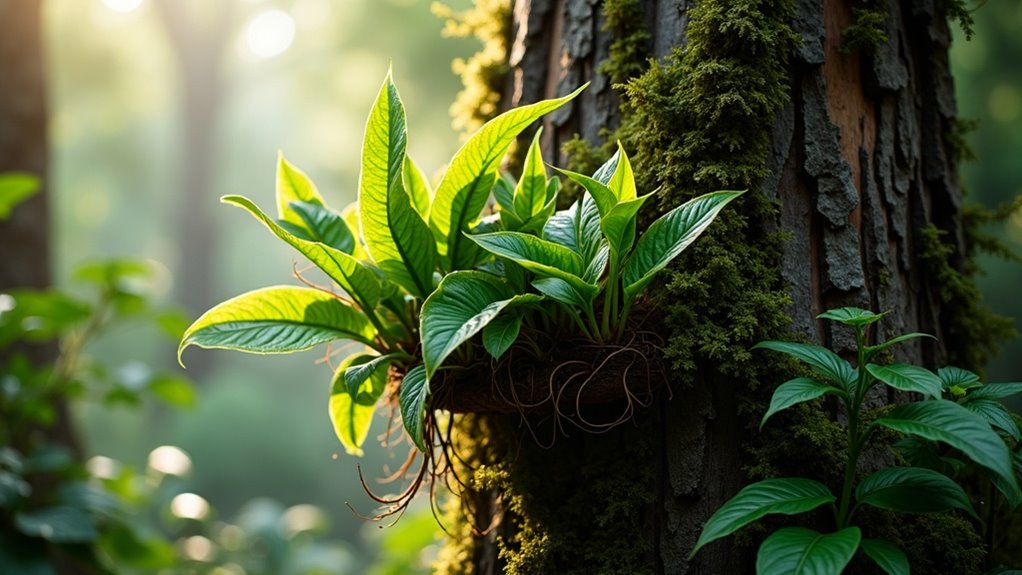
Epiphyte plants anchor themselves primarily on other plants, especially trees, using specialized root structures. These roots provide physical support without extracting nutrients from their host. Instead, they collect moisture directly from the air and surrounding debris, thriving in humid environments. This unique adaptation allows epiphytes to survive without soil. By understanding their growth habits and needs, you’ll gain deeper insights into their fascinating ecology and how to cultivate them as houseplants.
Key Takeaways
- Epiphytes anchor themselves to host plants, primarily trees, using specialized root structures for stability.
- Velamen roots provide physical support while absorbing moisture and nutrients from the air.
- These plants do not extract nutrients from their host but rely on surrounding organic debris.
- High humidity environments enhance their ability to thrive without soil.
- Some epiphytes, like hemiepiphytes, develop roots that eventually access soil for additional support.
Understanding Epiphytes and Their Growth Habits
While you might typically think of plants as needing soil for growth, epiphytes challenge this notion by thriving on other plants, particularly trees.
These unique plants anchor themselves using specialized roots, which provide physical support without extracting nutrients from their hosts. Found in high humidity environments, epiphytes like orchids and bromeliads absorb moisture directly from the air and surrounding debris.
Their roots, often adapted for moisture retention, enable them to flourish in the canopy. Seeds dispersed by animals frequently germinate in organic matter on tree branches, creating an ideal substrate for growth, demonstrating their remarkable ability to adapt and thrive in diverse ecosystems.
Types of Epiphytes: True, Hemiepiphytes, and More
Epiphytes can be classified into several categories based on their growth habits and ecological adaptations, each demonstrating unique strategies for survival in their aerial environments.
True epiphytes, or holo-epiphytes, remain entirely attached to host plants, deriving moisture and nutrients solely from air and organic debris.
Hemiepiphytes, like strangler figs, initially grow in the canopy but develop aerial roots that extend to the ground for soil resources.
Facultative epiphytes adapt to both aerial and soil conditions, allowing them to thrive in diverse habitats.
Accidental epiphytes germinate opportunistically on branches but lack the necessary adaptations for long-term survival without soil, primarily existing among flowering plants in tropical forests.
Adaptations for Thriving Without Soil
Many epiphytes exhibit remarkable adaptations that enable them to thrive without soil, relying instead on their unique physiological features. Various epiphyte species showcase specific root modifications, such as velamen roots, which anchor themselves to host trees while efficiently absorbing moisture and nutrients directly from the air. Additionally, some, like Tillandsia, utilize trichomes to capture resources, reducing reliance on traditional root systems. Hemiepiphytes, such as certain philodendrons, adapt by growing both in the canopy and in soil. These adaptations allow epiphytes to flourish in nutrient-poor environments, illustrating their resilience and evolutionary prowess.
| Adaptation Type | Function |
|---|---|
| Velamen Roots | Anchor and absorb moisture and nutrients from the air |
| Trichomes | Capture moisture and nutrients directly from the environment |
| Hemiepiphytes | Adapt to varying conditions, utilizing both canopy and soil |
| Root Modifications | Enable survival in nutrient-poor environments |
Watering and Nutritional Needs of Epiphytes
How do epiphytes manage their watering and nutritional needs without soil?
Epiphytic species anchor themselves using specialized root structures primarily for stability, not water absorption. They thrive in high humidity, obtaining water and nutrients from rain, air, and accumulated debris.
Effective moisture absorption occurs through adaptations like trichomes on leaves and velamen on roots. Proper watering practices, such as frequent misting or soaking, mimic their natural environment, ensuring rapid drying to prevent root rot.
Additionally, bromeliads utilize leaf cups to store water, capturing nutrients from decomposing matter and insects, fulfilling their nutritional needs without reliance on soil.
Popular Epiphytes to Grow as Houseplants
Looking to enhance your indoor garden with unique plants? Consider popular epiphytic houseplants like Phalaenopsis orchids, which thrive in indirect light and require frequent misting to maintain humidity.
Air plants, or Tillandsia, absorb water through their leaves, making them low-maintenance and perfect for modern decor.
Staghorn ferns can be mounted on walls, needing high humidity and indirect light to grow their distinctive fronds.
Hoya, or wax plants, bloom fragrant flowers while thriving in bright, indirect light with minimal watering.
Finally, Bromeliads, such as Guzmania and Aechmea, showcase vibrant colors and require well-draining substrates and humidity to flourish.





