
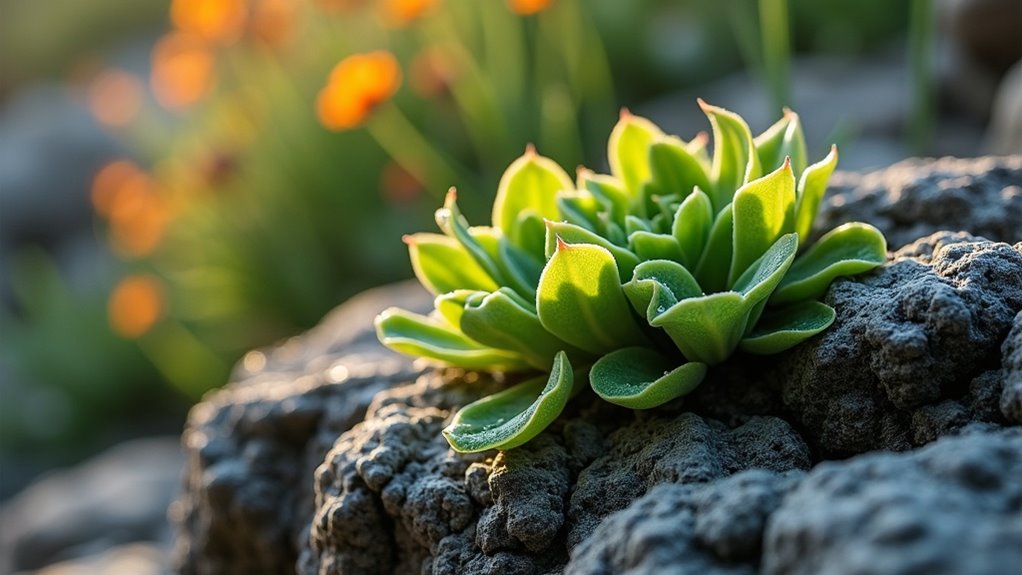
Lithophytes are specialized plants that grow on rocks, adapting to nutrient-poor conditions. Examples include mosses, the licorice fern (*Polypodium glycyrrhiza*), and various orchids like *Dendrobium teretifolium*. These plants attach to rock surfaces or inhabit crevices, utilizing rainwater and organic matter for nutrients. Their unique mechanisms for survival and nutrient acquisition set them apart from other plants. If you’re interested, there’s much more to explore about their ecological roles and conservation efforts.
Key Takeaways
- Lithophytes grow on rocks and include epilithic plants that thrive on rock surfaces and endolithic plants found in rock crevices.
- Examples of lithophytes include mosses, licorice fern (*Polypodium glycyrrhiza*), and various orchids like *Dendrobium teretifolium*.
- Wallflower (*Erysimum cheiri*) and carnivorous plants like *Nepenthes campanulata* also exhibit lithophytic growth on rocky surfaces.
- Obligate lithophytes depend solely on rocks for nutrients, while facultative lithophytes can utilize both rocks and soil.
- These plants stabilize rocky substrates and contribute to nutrient cycling in their ecosystems.
Definition and Types of Lithophytes
Lithophytes, fascinating plants that thrive on rocks, exhibit remarkable adaptations to survive in nutrient-poor environments with little to no soil.
You’ll find two primary types of lithophytic plants: epilithic, growing on the rock surface, and endolithic, residing within rock crevices. Obligate lithophytes depend exclusively on rock surfaces for survival, while facultative lithophytes can adapt to both rocks and soil.
Some lithophytes also exhibit versatility, existing as tree-dwelling epiphytes. Common examples include mosses, specific ferns like Polypodium glycyrrhiza, and various orchids, all showcasing the unique ecological strategies lithophytic plants utilize to thrive in their challenging habitats.
Nutrient Acquisition and Ecosystem Role
Lithophytes acquire nutrients primarily from rainwater and organic matter, utilizing specialized mycorrhizal relationships to enhance uptake efficiency.
They also absorb atmospheric ammonia, fulfilling their nitrogen requirements through a concentration gradient.
Additionally, their decomposition enriches the surrounding ecosystem, contributing to nutrient cycling and stabilizing substrates to prevent erosion.
Nutrient Sources for Lithophytes
While many plant species thrive in nutrient-rich soils, those that inhabit rocky environments, such as lithophytes, have adapted unique strategies for nutrient acquisition.
Lithophytes primarily obtain nutrients from rainwater and decaying organic matter that washes into their root systems. They also utilize gaseous ammonia (NH3) from the atmosphere, absorbed via a concentration gradient through glutamine synthetase for nitrogen.
Additionally, associations with arbuscular mycorrhizal fungi enhance their nutrient and water uptake. Lithophytes further contribute to the nutrient cycle by breaking down organic matter, enriching their ecosystem, and doing so without harming the rock surfaces they inhabit.
Role in Ecosystem Health
Although often overlooked, the role of lithophytes in ecosystem health is significant, particularly in nutrient acquisition and cycling. These plants thrive in rocky environments, drawing nutrients from rainwater and organic debris. They enrich surrounding soil, enhancing biodiversity.
| Function | Impact on Ecosystem | Contribution to Nutrient Cycling |
|---|---|---|
| Nutrient Acquisition | Supports plant growth | Enhances soil fertility |
| Erosion Prevention | Stabilizes rocky surfaces | Maintains soil integrity |
| Habitat Provision | Supports diverse organisms | Increases ecosystem resilience |
| Mycorrhizal Interaction | Improves nutrient uptake | Facilitates nutrient exchange |
| Decay Contribution | Enriches soil through decay | Sustains nutrient cycles |
Examples of Lithophytes
A variety of plants demonstrate lithophytic characteristics, showcasing their remarkable adaptability to rocky environments.
Mosses, for instance, attach to rocks with tiny rhizomes, stabilizing the substrate. The licorice fern (*Polypodium glycyrrhiza*) thrives in cliff crevices, exemplifying resilience in such habitats.
Mosses and the licorice fern showcase remarkable resilience, thriving in rocky crevices with their unique adaptations.
Various orchids, like *Dendrobium teretifolium*, grow as epiphytes on rock surfaces, displaying their unique adaptation strategies. Wallflower (*Erysimum cheiri*) emerges from cracks in rocky slopes, illustrating the determination of lithophytes.
Additionally, carnivorous plants such as *Nepenthes campanulata* flourish on rocky surfaces, obtaining essential nutrients by consuming prey, further emphasizing the diversity of plants that grow in challenging environments.
Distinction From Other Plant Types
When you examine lithophytes, it’s vital to distinguish them from epiphytes, as the former grow directly on rocks while the latter depend on other plants for support.
Additionally, lithophytes demonstrate unique attachment mechanisms and exhibit varying soil dependency, with some thriving solely on rock surfaces.
Understanding these distinctions clarifies their adaptive strategies in nutrient acquisition and environmental resilience.
Epiphytes vs. Lithophytes
While both lithophytes and epiphytes are unique plant types adapted to specific environments, they differ fundamentally in their growth habits and nutrient acquisition strategies.
Lithophytes specifically grow on rocks, relying on the rock surface for support and deriving nutrients from debris and weathered materials. They include epilithic types on rock exteriors and endolithic types in crevices.
In contrast, epiphytes grow on living plants without drawing nutrients from them, absorbing moisture and nutrients from the air.
Lithophytes exhibit adaptations like fewer root hairs for efficient nutrient extraction, whereas epiphytes develop features for water retention and light capture in forest canopies.
Soil Dependency Comparison
Lithophytes stand apart from traditional plants due to their minimal reliance on soil for growth and nutrient acquisition. Their unique adaptations allow them to thrive in environments where soil is scarce or absent.
Consider these distinctions:
- Lithophytes anchor directly to rocks rather than using soil.
- They absorb nutrients from debris and atmospheric moisture.
- Unlike epiphytes, lithophytes don’t harm their support structure.
- True lithophytes flourish without soil underneath them.
- They withstand extreme temperatures, enabling survival in harsh conditions.
These characteristics clearly differentiate lithophytes from typical soil-dependent plants, showcasing their remarkable resilience and adaptability.
Attachment Mechanisms Explained
Understanding the attachment mechanisms of lithophytes reveals their remarkable adaptations for survival in rocky environments.
Unlike epiphytes that depend on other plants for support, lithophytes secure themselves to rocks using specialized structures like rhizomes and adhesive features. Many species, such as mosses and ferns, develop tiny root hairs that penetrate crevices, enhancing grip and moisture access.
Additionally, biofilms of microorganisms, including fungi, play an essential role in stabilizing roots and facilitating nutrient absorption.
These attachment mechanisms enable lithophytes to thrive in harsh habitats, demonstrating their unique evolutionary strategy to withstand extreme conditions where soil is limited or nonexistent.
Ecological Importance
When evaluating the ecological importance of lithophytes, one can appreciate their critical role in stabilizing rocky surfaces and preventing soil erosion. Their presence is essential for several reasons:
- They stabilize substrates, maintaining habitat integrity.
- Lithophytes contribute to nutrient cycles by breaking down organic matter.
- They provide habitat and shelter for insects, small mammals, and other plants.
- By capturing moisture, lithophytes create microhabitats supporting diverse species.
- Their presence indicates environmental health, showcasing ecosystem resilience.
Conservation of Lithophytes
While habitat destruction and climate change pose significant threats to various plant species, lithophytes remain particularly vulnerable in rocky ecosystems. Effective conservation efforts are essential for their survival. Protecting habitats prevents soil erosion and supports biodiversity, while initiatives focus on preserving native lithophyte species as indicators of ecosystem health.
| Conservation Efforts | Description |
|---|---|
| Habitat Protection | Safeguarding areas where lithophytes thrive |
| Species Preservation | Focus on native lithophyte species |
| Community Outreach | Educational programs to raise awareness |
| Research Initiatives | Studying ecological roles for strategies |
Engaging the public is crucial for promoting these conservation efforts.





