
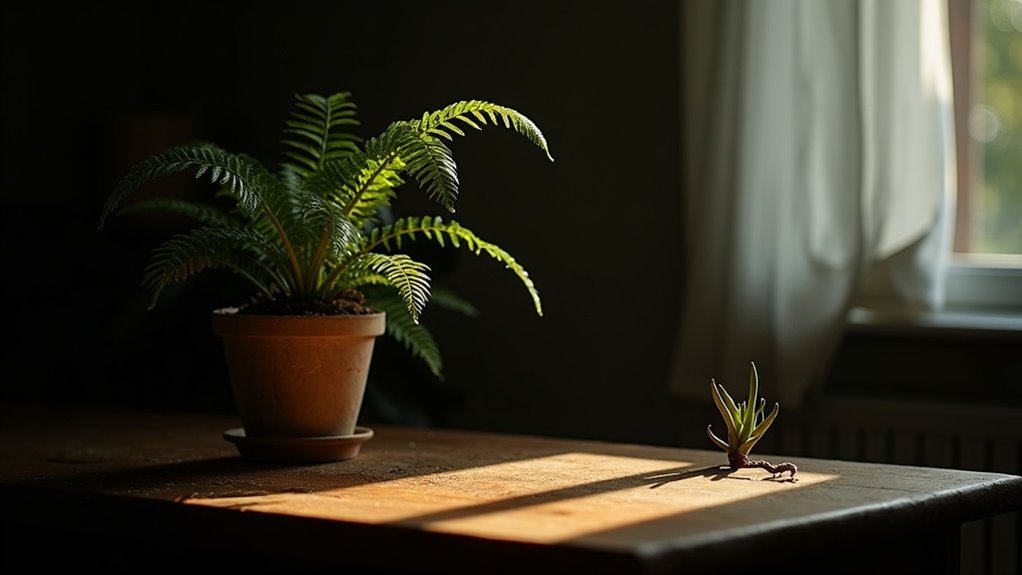
Plants can’t survive without sunlight for long. Sunlight is essential for photosynthesis, the process that converts carbon dioxide and water into energy. While some plants may endure short periods of darkness, prolonged absence of light leads to weak, spindly growth and eventual death. Different species have varying light needs, and their adaptations can influence survival short-term. If you’re curious about how specific plants cope with low light or the consequences of light deprivation, there’s more to discover.
Key Takeaways
- Plants require sunlight for photosynthesis, which is essential for energy production and growth.
- Prolonged absence of light leads to weak, spindly growth and eventually death.
- Some plants can survive short periods without light but will decline over time.
- Parasitic plants indirectly depend on sunlight through their host plants, which require light for survival.
- Long-term survival without sunlight is impossible for all plants, highlighting its vital role.
The Role of Sunlight in Plant Growth
Sunlight plays an essential role in plant growth, as it fuels the process of photosynthesis, where plants convert carbon dioxide and water into energy-rich sugars.
Chlorophyll, the green pigment in plants, absorbs sunlight’s red and blue wavelengths, exciting electrons necessary for this energy production. Without adequate sunlight, plants struggle to produce sufficient chlorophyll, leading to weak, pale, and spindly growth.
Chlorophyll absorbs sunlight’s red and blue wavelengths, essential for robust plant growth and energy production.
Different species have unique light requirements; some thrive in low-light conditions, while others need direct sunlight.
Ultimately, all green plants depend on sunlight for survival, as they can’t sustain long-term health without it, highlighting its critical importance.
Short-Term Survival Strategies for Plants
While most plants rely heavily on sunlight for long-term health, they possess remarkable short-term survival strategies to endure periods of darkness. Many plants can survive days to weeks without light, depending on species and growth stage.
In the absence of light, some may exhibit etiolation, growing taller and spindlier to reach light, though this can weaken them. Dormant cacti and succulents excel, surviving months due to their storage capabilities.
Parasitic plants like broomrape bypass sunlight entirely by drawing nutrients from hosts. However, prolonged darkness will eventually deplete resources, reminding us that while plants can survive temporarily, light is important for well-being.
Long-Term Consequences of Light Deprivation
Prolonged light deprivation can lead to severe consequences for plant health and viability. Without natural light, plants can’t perform photosynthesis, which is essential for energy production.
While some may survive short periods of darkness, extended deprivation results in etiolation, causing weak and spindly growth. Even parasitic plants depend on sunlight indirectly, as they rely on host plants that require light for photosynthesis.
Extended darkness leads to etiolation in plants, resulting in weak growth, highlighting the indirect reliance of even parasitic species on sunlight.
Additionally, the ecosystem’s balance hinges on this energy cycle; fungi that support mycoheterotrophic plants will eventually run out of resources.
Ultimately, no plant can thrive long-term without light, emphasizing how vital sunlight is for all plants.
Adaptations of Plants to Low Light Conditions
In low light conditions, plants employ various adaptations to survive and thrive.
You might notice etiolation, where stems elongate and leaves grow pale as they stretch toward any available light.
Additionally, some plants develop broad, thin leaves or even rely on fungi for nutrients, showcasing the diverse strategies that enable plant life to persist in challenging environments.
Etiolation Growth Strategy
When light is scarce, many plants resort to etiolation, a fascinating growth strategy that enables them to survive in low light conditions.
During etiolation, plants elongate their stems and produce pale leaves, minimizing chlorophyll as they seek light. This adaptation diverts energy toward vertical growth, leading to tall, spindly shoots that may appear weak.
While this strategy allows a temporary survival in darkness, prolonged etiolation results in stress symptoms, like yellowing leaves and stunted growth, indicating insufficient light for ideal photosynthesis and carbon dioxide absorption.
Different species exhibit varying resilience, impacting their survival in shaded environments.
Low-Light Plant Adaptations
Although many plants prefer bright light, several species have developed remarkable adaptations to thrive in low-light environments.
Low-light plants, like ferns and snake plants, often feature broad, thin leaves that maximize sunlight capture, which is essential for photosynthesis. These plants typically grow slower than their high-light counterparts, relying on energy-conserving adaptations.
Etiolation also plays a role, where plants stretch towards light, resulting in elongated stems and pale leaves. Additionally, unique pigments allow these species to absorb wavelengths less available in shaded areas, enhancing their survival.
Understanding these adaptations helps you appreciate the resilience of plants in challenging conditions.
The Impact of Darkness on Different Plant Types
While all plants can endure short bouts without sunlight, the specific effects of darkness vary greatly among different types.
Dormant cacti and succulents can survive weeks to months without light, while parasitic plants like broomrape depend on host plants, indirectly relying on sunlight.
Mycoheterotrophic plants extract energy from fungi, which ultimately need sunlight, highlighting that no plant can thrive in permanent darkness.
Etiolation occurs in many plants, causing them to grow tall and spindly as they seek light, compromising their health.
Consequently, it’s a good idea to guarantee plants receive enough light, as prolonged darkness can lead to serious physiological changes.
Providing Adequate Light for Healthy Plants
Providing adequate light is essential for healthy plant growth, as most plants depend on sunlight for photosynthesis, the process that converts carbon dioxide and water into energy.
You should understand that different plants require varying light intensities; low-light species can thrive in shaded areas but still need some light to photosynthesize. Medium-light plants flourish near east-facing windows, while high-light plants require direct sunlight from south or southwest-facing windows.
If your plants aren’t getting enough light, they may exhibit leggy growth and pale leaves. Consider using supplemental lighting, like LED grow lights, to guarantee your plants grow strong and healthy.





